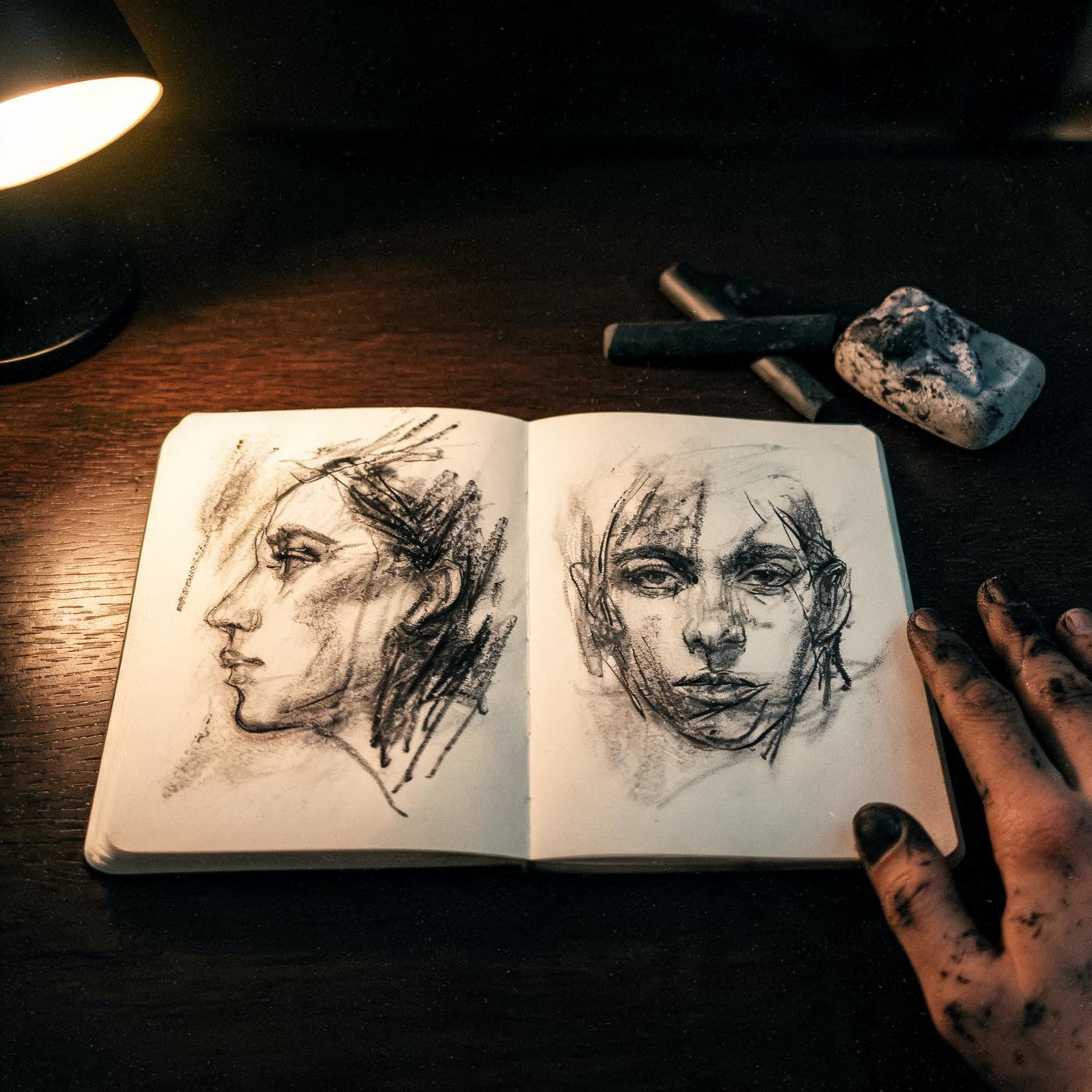
The #ArtDrawing trend has been everywhere on TikTok this week, people sharing their sketchbooks, their practice routines, their process videos, and I keep stopping to watch them in a way I don't stop for most content. Because drawing was mine first. Before Sunday the guitar. Before I learned three chords and decided that was enough to start writing songs. Before any of this. I had sketchbooks.
I've never really talked about this publicly, which is funny because it's such a central part of how I think and make things. Musicians don't always talk about their visual practice. There's this implied specialization, you're a musician so you do music, and if you draw or paint or build things that's a hobby rather than a real part of the creative identity. I think that's wrong. I think the things you made before you found your "main thing" are not background noise. They're the foundation. They're what you were learning to think before you found the medium where you could think loudest.
So let me actually tell this story, because HEATHEN HYMNS is out and the visual world of this album is something I care about deeply, and it came from exactly the same place as everything else: the sketchbooks I kept starting at age seven.
Sketchbooks Before Songbooks
I grew up in a small Southern town where the two available artistic outlets for a kid who wasn't sporty were choir and drawing. I was in choir (front-row girl, the one who had the memorized harmonies and slightly too much enthusiasm for a Wednesday night service). But drawing was the one I did alone, in my room, for no audience. It was the private thing.
I drew everything. Faces, mostly. I was obsessed with faces, with the specific weight of an expression, how much story lives in the angle of an eyebrow or the tension in a jaw. I'd draw the same face forty different ways trying to get a particular feeling right. Later I'd understand that this is exactly what you do with a song. You write the same idea twelve different ways until the phrasing is right, until the chord supports what the lyric is doing, until the melody lands the emotion you're actually going for. But I learned that process through drawing first.
I kept sketchbooks continuously from age seven until my late teens, when music took over my primary creative energy. But "took over" isn't quite right. It's more like drawing became the substrate and music became what I built on top of it. The habits of thought I'd developed through visual art (looking hard at things, trying to capture specificity rather than generality, being willing to do something ugly on the way to something right) all of that was already wired in when I started writing songs.
How Visual Art Lives in the Music
When I write a song, I almost always have a visual in mind before I have a complete melody. Not a music video. Just an image, a color palette, a scene. The songs on HEATHEN HYMNS have distinct visual identities in my head. Some of them I can't fully describe without it sounding either pretentious or vague, but they're real and specific.
There's a track that, in my head, is completely amber and brown. Warm like old wood, but with a shadow in the corner that doesn't move. That color informed the arrangement choices. The warmth of the acoustic treatment, the way the reverb sits back instead of spreading. If you don't know I was thinking amber, you still might feel the warmth. The image does work under the surface even when it's invisible.
This is something visual artists will understand immediately and some people who think of music as purely sonic will find strange. But I'd argue that all serious makers eventually discover that the thinking tools you develop in one medium are portable. The painter who writes in a journal. The writer who photographs. The musician who draws. These aren't distractions from the main practice. They're the practices that keep the main thing from going stale, because they require you to use different muscles in the same underlying creative thinking.
The Cover Art Process
The visual identity of HEATHEN HYMNS (the album art, the single covers, the overall look) came directly from my drawing practice. I did the initial concepting entirely in my sketchbook. Pages and pages of rough ideas: compositions, type approaches, imagery, color relationships. I was working from the same instinct I'd had at age seven. Draw it ugly first, draw it many times, and the right version eventually surfaces.
I knew from early on that I wanted something that felt sacred and transgressive simultaneously. Not just shocking (there's nothing interesting about pure transgression, it's too easy) but something that could genuinely look like devotional imagery and also feel like a door into something the devotional tradition wanted to keep closed. That tension is the whole album in a single image: someone who loved the sacred thing, who knows it from the inside, who isn't outside looking in but who has walked out from inside looking back.
The final execution involved a designer I worked with closely. I handed off specific sketches and extensive notes about what I wanted it to do emotionally, not just what I wanted it to look like. The difference is important. "I want it to look like X" produces an aesthetic. "I want it to make someone feel Y" produces a design with an intention. The sketchbook process is how I figure out the Y before I even think about the X.
What Drawing Gives You That Nothing Else Does
I've tried to understand why I keep coming back to drawing even when I'm deep in a musical project, and I think I've figured out a few things about what it gives me that the other practices don't.
First: drawing is immediate and physical in a way that music production often isn't. When I'm working in a DAW, there are layers of technology between me and the sound. Clicks and menus and settings. Drawing is hand on paper. There's almost no mediation. That directness does something specific for the nervous system. It's why I draw when I'm stuck on a song, not to solve the musical problem visually, but to reset the connection between "thing in my head" and "thing on the surface in front of me." It reminds my hands and my mind that the connection is direct.
Second: drawing forces slow looking in a way that is incredibly rare in the current media environment. To draw something you have to actually look at it. Not glance at it, not process it enough to identify it and move on, but actually observe it, hold it, understand its parts and how they relate. That quality of attention is a practice, and it makes you better at perceiving everything. It makes you a better listener because you've trained yourself to stay with a thing longer than is immediately comfortable.
Third: the sketchbook is a place where being bad is expected and normal and unimportant. You can't perform in a sketchbook. Nobody's going to see it unless you decide to share. Most pages are not good and that is FINE. They're working pages, thinking pages, the visual equivalent of the voice memo you record on your phone at midnight to capture an idea before it disappears. Having a place where being bad is allowed keeps the rest of the creative work from getting too precious. The sketchbook is permission to fail fast, and the practice of failing fast in one place keeps you from being too afraid to try in the others.
What HEATHEN HYMNS Looks Like to Me
Here's the image I had in my head when I was finishing the album. Not the cover, not a music video concept, but the internal image, the one I carry when I think about the whole record as an object:
A figure standing in the doorway of a church. Not inside. Not outside. In the threshold. The light is behind her (warm and amber, exactly the color I described earlier) and in front of her it's cooler, bluer, more uncertain. She's not looking back and she's not fully facing forward. She's just standing there. She's okay.
That image took me years to get to. I drew probably thirty versions of it, in different configurations, before I had the songs that told me what it actually meant. The drawing and the music made it together, the same way they always have for me, the same way they probably always will.
If you've got a sketchbook gathering dust somewhere: open it. It doesn't matter if you're "good." It's not about good. It's about the thinking that happens when your hand is moving and your head is quiet enough to see what it makes.
I still draw. Not as much as I did at seven, and not with the same intensity that I bring to songwriting, but consistently enough that the sketchbook is always somewhere near the desk. Sometimes it's just warm-up, the visual equivalent of a few scales before a real practice session. Sometimes something comes out of it that goes directly into a lyric or a visual concept. idk, it's not always clear which. But the practice itself is the point, and I've never regretted a single page of it, even the bad ones, especially the bad ones.
Anyway. If you're someone who draws or used to draw and drifted away from it, this is your nudge. The sketchbook isn't going to judge you for having been gone. It'll just be there when you pick it up, ready to receive whatever's in your hands.