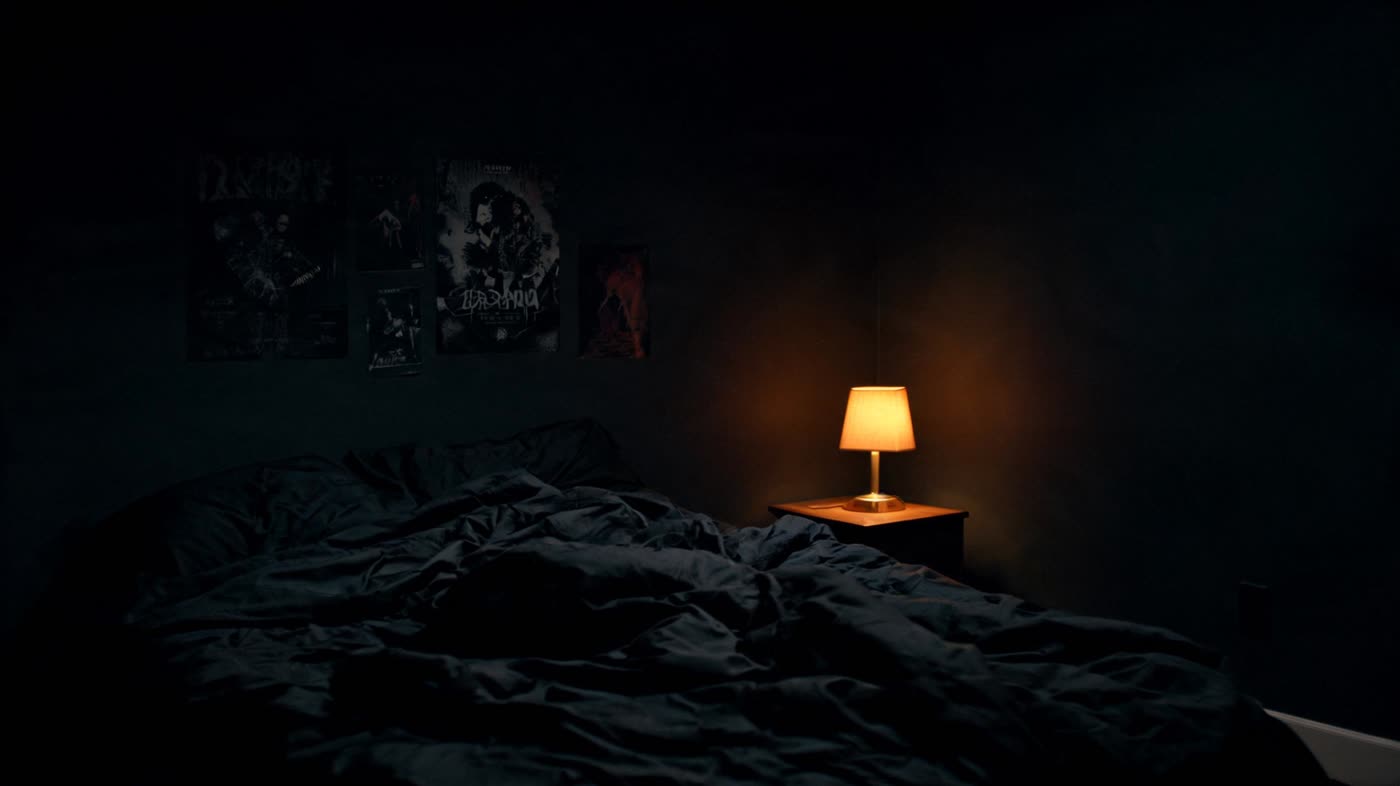
I want to talk about the overhead light. The main light. The big light. The ceiling fixture that exists in approximately every apartment ever built in America and that I have not turned on in my bedroom in over two years.
The bedroom lamp aesthetic is trending and I am fully behind this. If you've been watching the content: people showing their layered lamp setups, their warm-toned ambient glow, their bedroom spaces that look like somewhere a person actually lives instead of a room waiting to be inspected. This trend has been doing numbers for a reason and the reason is that we have all, collectively, been living under overhead lighting that does not serve us and we have started to say so out loud.
I have opinions about this that I've developed over years of living in a small city apartment on a musician's budget, arranging space for both sleeping and creating, and gradually arriving at a lighting philosophy that I now consider basically non-negotiable. It is the only design religion I still practice. The only one I trust. And I'm here to explain it with the fervor of the recently converted, which is how I approach most things I actually believe.
The case against overhead lighting (in bedrooms specifically)
I'm not saying overhead lighting is evil in all contexts. In a kitchen, overhead lighting is appropriate and necessary. You need to see the cutting board. You need to be able to tell if the chicken is done. Fine. In a bathroom, I've covered this in a separate post, but at minimum the overhead fixture is there to keep you from slipping in the shower. I accept this.
In a bedroom, overhead lighting is an act of aggression against the space and against yourself.
The bedroom is supposed to be the room where your nervous system winds down. Where you transition from the engaged, activated, bright-world state into the rest state. Overhead lighting is bright-world lighting. it says: be alert. It floods the room evenly from above, eliminating shadows, maximizing lux, communicating to your brain via your retinas that it is daytime and you should be doing things. Your melatonin production gets suppressed. Your eyes stay wide. You're lying in bed asking yourself why you can't sleep while a fluorescent-spectrum light fixture directly above you tells your biology it's noon.
The bedroom lamp aesthetic is not just a vibe. It's physiologically sound. Warm-toned, low-level light from below eye height is genuinely less disruptive to the sleep-onset process than overhead lighting. The trend is beautiful and it's also correct, and I love when those two things happen at the same time.
lamp layering on a budget: what I actually have
I am not a person with a home decor budget. I'm a person who has furnished an apartment over years via a combination of thrift stores, things people were throwing out, and the occasional deliberate purchase of something I knew I needed. My lamp collection reflects this history and I'm proud of every piece of it.
The primary lamp is on my nightstand, a small ceramic base lamp with a shade I replaced because the original shade was that specific shade of synthetic cream that makes everything look medical. The replacement shade is a warm linen that diffuses the light into the walls and ceiling instead of projecting it outward. Warm enough to read by and dim enough to not fight with sleep onset. This lamp is a secondhand find from three years ago and it has done more for my quality of life than the majority of deliberate purchases I've made.
The secondary lamp is on the floor in the far corner, a tall lamp with a bulb pointed up at the ceiling, creating a wash of ambient light that has no central source. This one I bought new because I needed specific height and I couldn't find what I wanted used. Not expensive. The effect is: the room is lit but you can't find the source, which is the correct feeling for a bedroom at night. You're not in the dark and you're not being interrogated by a fixture.
The third element is a string of warm LED lights running along the top of my bookshelf, not the tacky-Christmas-lights-in-a-dorm vibe, just a warm line of light at a high-but-horizontal level that adds dimension without adding brightness. This cost very little and made a disproportionate difference. My secondhand chair in the corner, under that line of light, is the most comfortable reading spot I've had in any apartment I've ever lived in.
The closet studio shares a wall with the bedroom. I have a small lamp in there too, the only light I use when I'm tracking late at night, and the warmth of it creeps under the closet door and into the bedroom, which sounds negligible but reads as presence. The room knows someone is working. It's cozy, weirdly.
warmth as a design religion
I grew up in a house where warmth was not the design priority. Functional house, clean, well-maintained, not cozy. The overhead lights were always on if any room was occupied. The decor was minimal and practical. Nothing wrong with that. It just meant I didn't grow up with a language for what I was looking for in a space, only the knowledge that what I had didn't feel like what I wanted.
The first apartment I lived in alone, I spent one evening sitting on the floor surrounded by the very few things I owned and thinking: what do I want this place to feel like? And the answer that came was: warm. I want it to feel like somewhere worth staying. Like the light is glad I'm here. That sounds extremely dramatic for a decorating decision but it's genuinely what I was going for.
Everything I've done to spaces since then has been toward that goal. Warm bulb temperatures, 2700K is my non-negotiable, no cool white anywhere in my home, ever. Lamps rather than overhead fixtures wherever possible. Textiles that absorb light rather than reflecting it harshly. The candle on the desk that I light when I need the studio to feel sacred instead of just functional. Lazarus the pothos on the windowsill, hanging on stubbornly no matter how bad I am at watering him, adding green and life and something that isn't metal or screen.
It's a design philosophy and it's also, I'll admit, a coping mechanism. The world outside is bright and loud and demanding in ways I can't always control. The apartment is the one space where the ambient conditions are entirely my choice. And my choice is: warm. Low. Present. Safe.
practical notes for anyone who wants to start
If you're in an apartment where you can't rewire anything and you're working with existing overhead fixtures: buy a dimmer switch for lamps and stop using the overhead as your primary source. Most impactful change. Costs less than a fancy serum that won't do anything anyway.
Bulb temperature is everything. The "warm white" or "soft white" label on bulbs corresponds to lower Kelvin numbers, aim for 2700K to 3000K in any room where you want warmth. Cool white and daylight bulbs (4000K to 6500K) are for task lighting and kitchens and rooms where you're trying to be alert. They do not belong in a bedroom unless you are specifically trying to not sleep.
Height diversity makes a room. One lamp at table height and one at floor height and one at a higher ambient level creates a layered effect that doesn't read as "staged" but feels inhabited. Real spaces have varied light levels. Uniform ceiling-down light reads as commercial space, not home.
You don't have to spend money to do this well. The thrift store has lamps. The hardware store has bulbs. The difference between a room that feels right and a room that doesn't is often just the color and level of the light, which is one of the most accessible design variables there is.
The overhead light in my bedroom has been dark for two years. I have not missed it once. My sleep is still imperfect, insomnia is a persistent companion and I've stopped pretending otherwise, but the room I try to sleep in no longer fights me on the way in. It's warm and low and mine, and that's the only design religion I need.
I want to acknowledge that the bedroom lamp aesthetic, like most aesthetic trends, gets complicated when it hits the market. There are now "bedroom lamp aesthetic starter kits" being sold for significant amounts of money, curated warm-light setups in aesthetically consistent color palettes, the whole thing packaged and sold back as a lifestyle purchase. And look, some of that is genuinely nice if you have the budget and you find something you actually love. But the core principle is completely divorced from what you spend. The $8 lamp from the thrift store, rewired and fit with a $4 warm bulb, does the exact same thing as the $180 Instagram lamp. The light hits your eyes the same way. Your melatonin responds the same way. Your nervous system relaxes the same way. Warmth is not a luxury product. it's a bulb choice.
The reason I feel strongly about this is that for years I thought creating a space that felt right was something I'd do someday when I had money and a better apartment and a more settled life. That's the someday fallacy and it kept me in overhead-lit rooms that made me feel vaguely worse than I needed to. The switch, literally, buying a lamp and changing a bulb, took an afternoon and cost almost nothing and I haven't looked back. Your space can feel like yours right now. Not in the eventual-good-apartment future. The warmth is already possible. That's the part I want to leave you with: this is not aspirational. This is available. Go find a lamp with good bones and a warm bulb and live differently tonight.
Join me. Turn off the big light. Let the lamps have their moment. I promise you will not regret it and you can quote me on that from your very comfortable secondhand chair.