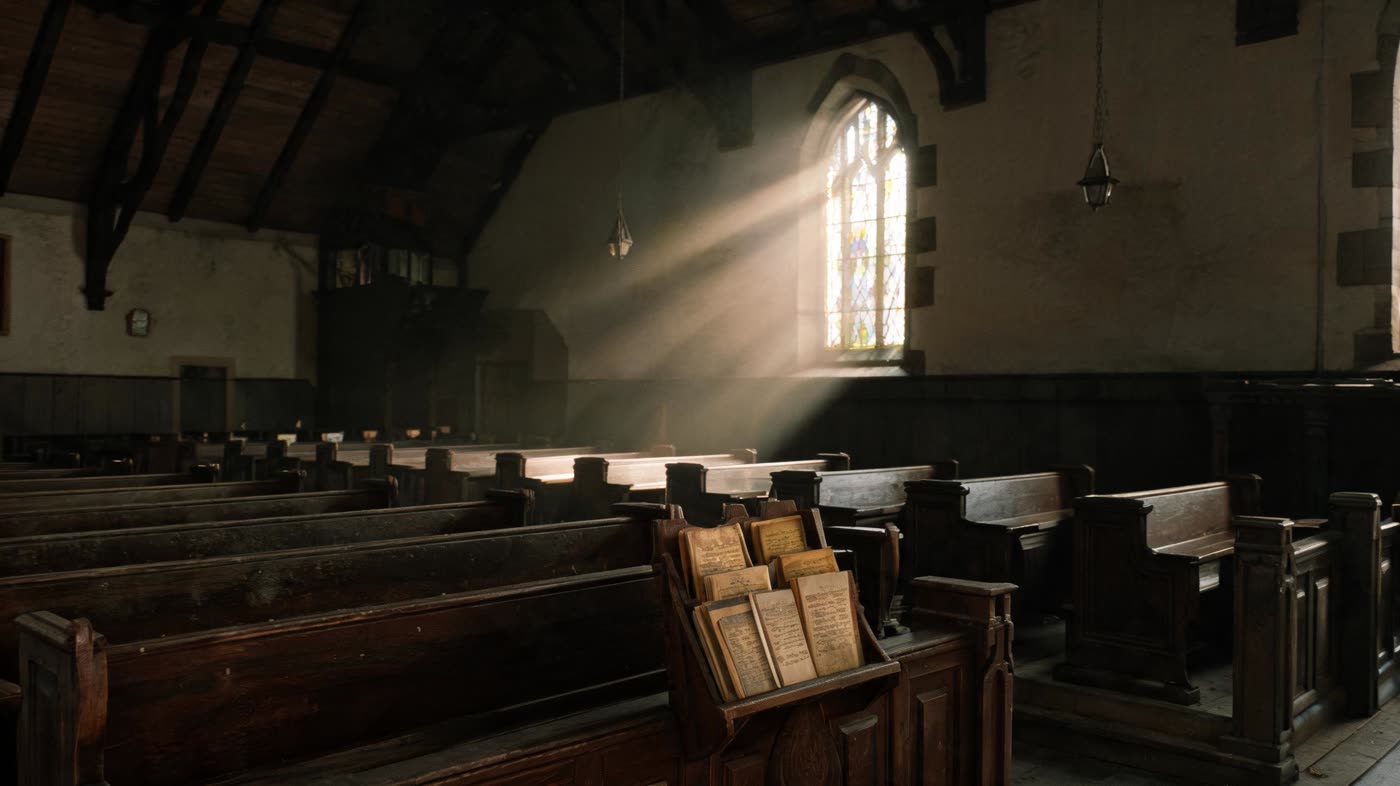
I grew up knowing something was different about me before I had any language for it. That's not a unique experience, it's the experience of almost every queer person who came up in a religious community, and I want to say that plainly so we don't dress it up into something it wasn't. It wasn't romantic and mysterious. It was the very specific, constant work of monitoring myself. Of editing myself before I spoke. Of building, over years, an internal censor that ran faster than my actual thoughts so that nothing inadvertent came out.
The Bible Belt is a geography and a culture and a political infrastructure all at once, and I grew up inside all three layers of it. The geography: real, I came from a small Southern town where the church was the town in every meaningful sense, socially, politically, architecturally. The culture: the water, the background noise, the assumed framework for all questions of meaning and morality. The political infrastructure: increasingly visible in ways that had not yet fully metastasized when I was a teenager but that I can trace clearly in retrospect.
Being bisexual in that environment meant that I existed in a particular kind of doubled silence. I was not gay in the way that the culture had constructed a specific story about. I was attracted to more than one gender, which means that for much of my adolescence I could almost convince myself that the attraction to women was something I could just... not follow. That I could be bisexual and live as if I weren't. That the door existed but I didn't have to open it. The closet for bisexual people in religious communities is sometimes less claustrophobic than for gay people because there's a pretend exit, and the pretend exit costs you something specific that I want to talk about.
the closet that had a door you couldn't use
The theological framework I was raised in didn't really have the concept of bisexuality. It had "homosexuality" as a category and it had "same-sex attraction" as the evangelical pastoral softening of that category. Both were sin, or "struggle," the pastoral word, which is a whole rhetorical move worth examining, and the expected response to either was repentance, prayer, and orientation toward a heterosexual life. The idea that someone might be genuinely and permanently attracted to more than one gender was either not conceived of, or dismissed as a particularly pernicious form of the same problem: "you're trying to have it both ways."
I heard that phrase. Literally. In a conversation with a church counselor I was sent to when I was nineteen and had, in a moment of profound unwisdom, said something to my youth leader that made her concerned. The counselor was not officially affiliated with conversion therapy, nothing so overtly labeled, but the structure of the sessions was: your attractions to women are not from God, they are from the wound or the confusion or the enemy, they can be healed, the healing looks like prayer and accountability and heterosexual marriage. What the counselor and I had for six months was the soft version of conversion-adjacent practice. The version that was deniable. The version where nobody uses the words but everyone knows what the goal is.
It didn't work, obviously. Not because I wasn't trying. I was trying extremely hard, with the complete earnestness of a nineteen-year-old who genuinely believed the framework and wanted the healing she'd been promised. It didn't work because there was nothing to heal. The attraction to women was not a symptom of damage. It was just part of who I was, and no amount of prayer restructures who you are.
What the six months of counseling did successfully produce was shame with a very specific architecture. Not diffuse shame, targeted shame, the kind that knows exactly which thoughts are the wrong ones and triggers a self-punishment response to them. I went into those sessions with a closet and came out with a closet that had been reinforced and padlocked from the inside.
Christian Nationalism and What It Wants From Me
I want to draw a line between the people in my community who held these beliefs in good faith and the political structure that is currently building law and governance on the foundation of those beliefs. These are not the same thing and I refuse to conflate them even when the conflation would be rhetorically convenient.
The people in my hometown church who believed homosexuality was sin were, most of them, trying to love me as they understood love. They were working within a framework they'd been handed and hadn't examined because the structure they lived inside didn't reward examining it. My church counselor thought she was helping. The youth leader who was concerned enough to send me was concerned in the way that people are concerned about something they believe will hurt you. The harm was real. The intentions were mostly not malicious.
Christian nationalism is a different animal. It is the political project of encoding those beliefs into law and governance, defunding the services queer people depend on, blocking healthcare access, passing legislation that makes LGBTQ people legally vulnerable in public life, in schools, in workplaces. Not pastoral concern about my soul. A power project using religion as its organizing principle, and the people at the top of that project are not confused about what they're doing. They know that "protecting children" is a laundering mechanism for "removing queer people from visibility." They know it. The rhetorical choices are deliberate.
As a bisexual woman, my specific position in that political landscape is strange. Bisexual erasure is a well-documented phenomenon even within queer spaces, let alone outside them. The Christian nationalist framework doesn't really have a category for me. I am either confused, or I am choosing sin, or I am claiming a hybrid identity to avoid accountability. The "you're trying to have it both ways" thing again, dressed in political clothes. The implication that bisexuality is a performance, a phase, an evasion, rather than a genuine orientation.
I am not confused. I am not in a phase. I am a thirty-two-year-old woman who has had enough life experience to know herself with some confidence, and I am bisexual. Not as a brand. Not as a political statement, though I understand that my existence is political in the current moment whether I intend it to be or not. Just as a fact about who I am and how I move through the world.
Refusing to Shrink
There is a pressure, subtle and constant and coming from multiple directions at once, to manage my bisexuality in ways that make other people comfortable. To not mention it too often, so I don't seem like I'm "making it my whole personality." To avoid being too visible about it in spaces where it might make things complicated. To choose, in the way that bi people are often implicitly asked to choose, a lane. Be with a man and let it go unremarked, or be with a woman and deal with what that means in every context. The middle is uncomfortable for people who need categories.
I have spent real time and real energy on this refusal. Not because I'm performatively defiant (I'm tired of performing defiance, it's exhausting) but because every inch I give is an inch I don't get back. Every time I decide it's too complicated to mention, every time I let a mischaracterization go because correcting it feels like too much today, every time I soften the edges of who I am to make a room easier, I am doing the closet-builder's work for them. And I've done enough of that work. I did six months of intensive work on it at nineteen and I don't owe anyone any more.
The songs I'm writing right now are about this, among other things. Not explicitly all of them, you can write about being queer without writing about being queer, the music can carry it without naming it, and sometimes the unnamed version lands harder because it leaves room for the listener. But the person writing them is a bisexual woman who was shame-trained by an institution and broke out of it, and that fact is in everything she makes whether or not she names it. It's in the song I'm working on tonight. It's in Sunday the guitar, who has been with me through all of it and never once suggested I should be different. Inanimate objects are more reliable allies than they get credit for.
To the People Still in That Room
I know you're reading this. You find me because the things I'm talking about are the things you're searching for at 1am from a phone you've got the privacy settings locked down on. I know the topology of that search history because I used to make it.
The door does not have to stay locked. Not today, not necessarily. I'm not here to tell you your timeline, and I know that the stakes of opening a closet door in a genuinely hostile community are real and sometimes severe. But I want you to know that the person they've built inside you, the internal censor, the shame with precise architecture, the prayer and the accountability and the exhausting daily work of monitoring yourself, that person is not all of you. The rest of you is still in there. The part that knew something before you had language for it, the part that is still real underneath everything they've layered on top of it.
You are not confused. You are not broken. You are not a struggle or a wound or a phase or someone trying to have it both ways. You are a person, specific and real, and the fullness of who you are is not a problem to be solved. I know it was presented to you as one. I know the presenter meant well, probably. It doesn't change what it is.
I'm here. The record I'm making is for you too. Even when it doesn't say your name directly, especially then, it's for you.