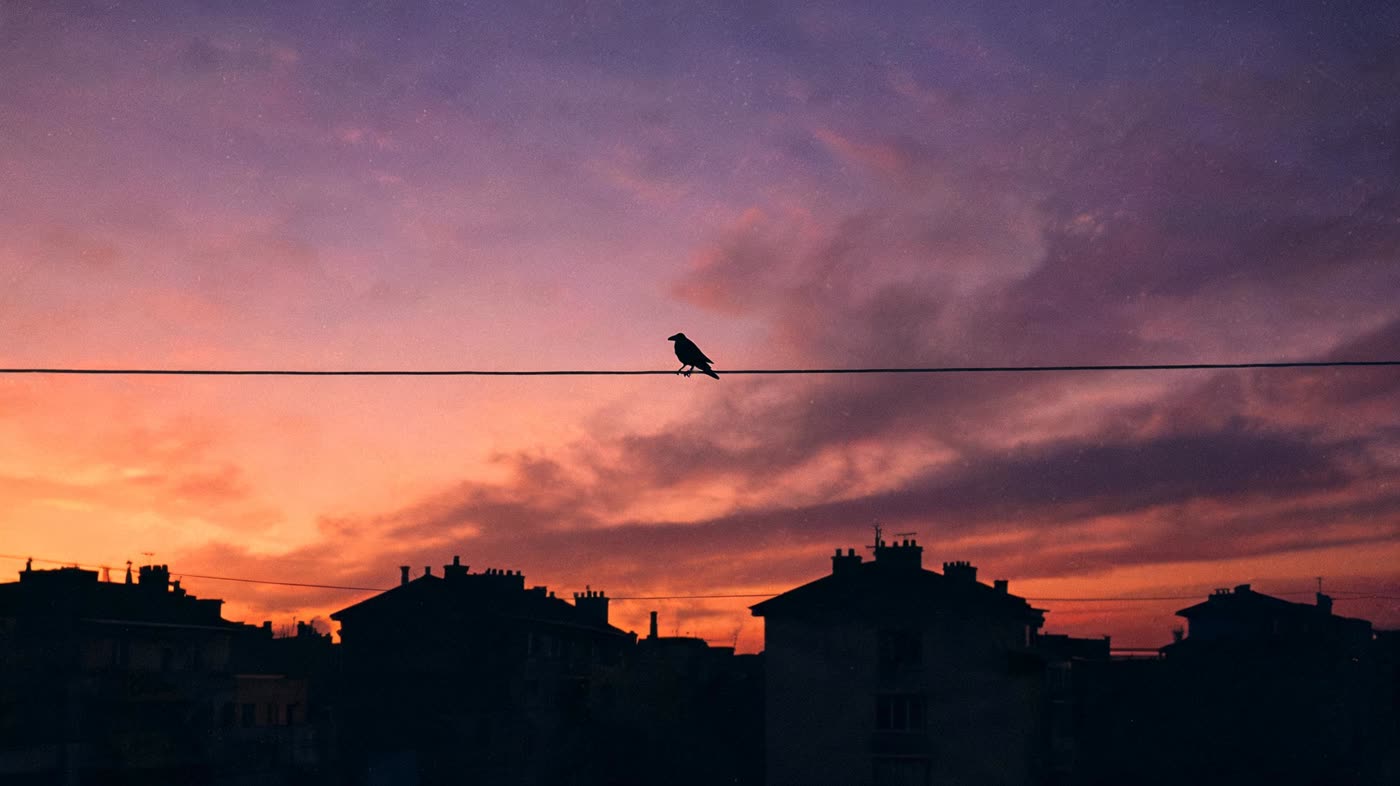
There is a crow outside my studio window who has a personal grudge against me.
I don't know what I did. I have no memory of any anti-crow offense. But this bird, I've started calling him Kevin, has been showing up on the fire escape ledge every morning for the past six weeks and screaming at approximately the loudest volume a crow's body can physically produce. He arrives between 7:15 and 7:30am, which is, in my world, still functionally the middle of the night. I record until 2 or 3am most nights. Kevin does not care about this. Kevin has an agenda and I am part of it.
Birdwatching has been trending hard on TikTok lately, I've been posting about it, and Kevin is directly responsible for my participation in this trend. He made me pay attention. He made me look out the window instead of at my screen. He made me notice that there's an entire world happening at bird-height outside my apartment that I had been completely ignoring for three years.
And now I can't stop watching. Which, listen, I did not see this coming for myself. But here we are.
Kevin and the Beginning
The thing about crows is that they're shockingly intelligent. I started looking them up initially to figure out how to make Kevin stop, and then fell down the research hole and forgot entirely about making him stop. Crows recognize human faces. They can hold grudges for years, which explains so much about Kevin specifically. They use tools. They teach their young. They've been observed leaving gifts for humans who treat them well, which is both adorable and slightly sinister.
There is a documented case of a crow family that began bringing small objects, beads, a piece of foil, a tiny broken earring, to a child who regularly fed them. They were giving her presents. A murder of crows (and yes, a group of crows is called a murder, which is the most metal taxonomic choice the English language ever made) operating a gift economy with a human child.
I read that and looked at Kevin and thought: okay. You're not just an inconvenience. You're a person. What do you want?
I started leaving peanuts on the fire escape. Kevin stopped screaming directly at my window. He moved his grievances to a ledge two floors up and now we have what I would describe as a detente. I don't fully understand what I did to earn his original wrath and I've accepted that I may never know. Some feuds are older than the evidence.
the birdwatching trend and why it makes sense now
The birdwatching TikTok trend has this beautiful split energy: half of it is the traditional, binoculars-and-field-guide crowd, very earnest, deeply knowledgeable, truly delightful, and the other half is people who've accidentally become obsessed the way I did. City people. Young people. People who were sitting near a window or walking past a park and something LANDED and looked at them and suddenly they needed to know what it was.
The Merlin app is apparently single-handedly responsible for radicalizing a generation of casual bird-noticers into actual birders. You hold up your phone and it listens and identifies the bird by its call in real time. This is science fiction technology being deployed to tell you there's a house finch in the tree you've walked past a thousand times and never actually seen. I downloaded it after the first Kevin incident and within one afternoon I had identified nine species from my apartment window.
Nine species. In one afternoon. In a city. From one window.
The world is absolutely full of living things going about their complete and total lives and we are just not looking.
paying attention is rebellious
The thing I keep coming back to, the thing I posted about on TikTok and that people responded to harder than I expected: in 2025, sustained attention is a radical act.
Everything about how the internet is built is designed to interrupt your attention before it can settle anywhere. The feed refreshes. The notification arrives. The reel ends and the next one begins before you've processed the one you just watched. Your brain never gets to fully land anywhere because landing is bad for engagement. You need to always be mid-swipe, mid-scroll, already reaching for the next thing before the current thing has finished existing in your awareness.
Birdwatching requires the opposite. It requires you to stand still and wait. To look at one spot of sky or branch or feeder without looking at anything else. To let the moment be slow enough that you actually see what's in it. To train your eyes to catch movement and your ears to separate one call from the ambient noise of everything else.
That is HARD right now. Genuinely difficult to just look at a bird. Not because birdwatching is complicated (it isn't, Kevin got me into it accidentally) but because your brain has been trained to need stimulation faster than a bird provides it.
Which is exactly why it's punk. Not in any performed, aesthetic way. In the structural sense. Birdwatching is structurally resistant to the attention economy. You cannot do it while doom-scrolling. You cannot do it impatiently. The bird doesn't care if you're in a hurry. The bird is going to do what the bird is going to do on the bird's timeline, and your job is to be present enough to catch it.
what it does to the music
I want to talk about this from the recording angle, because everything in my life filters through the record I'm currently making, and birdwatching has actually affected that in ways I didn't anticipate.
I've been sitting with some really dense emotional material for the songs I'm working on, songs that deal with belief and loss and anger and grief and all of that heavy cabinet-filing of a life, and the work of writing them requires a certain quality of attention that is very easy to lose when you're also online all the time. The creative part of the brain needs quiet to do its thing. Not silence necessarily, I work well with ambient noise, but quiet in the sense of not interrupted. Not pinged. Not fed a constant stream of other people's urgent things.
Watching Kevin for twenty minutes in the morning has become, unintentionally, a kind of attentional reset. My eyes go to something real and specific and present. My brain stops simulating what might be in my notifications. The crow eats a peanut and looks at me sideways and I feel, briefly, completely located in my own life.
Then I go back inside and write something that feels more true than what I would have written if I'd gone straight from my phone to my guitar without looking up. I don't know if I can prove causality there. But the correlation is real enough that I've made it a practice.
the field guide I now own
I have to tell you that I own a field guide. A physical, printed Sibley Guide to Birds, the big one, the full North American edition, which is almost two inches thick and absolutely sends my secondhand bookshelf into structural crisis every time I put it back. I bought it for twelve dollars at a used bookstore because the app is great but something about having the physical taxonomy in my hands felt important.
I don't know exactly when I became the kind of person who owns a field guide. I think it happened in the gap between Kevin starting his campaign and me figuring out how to negotiate a peanut-based truce. There was a week in there where I was genuinely staying up past my normal 2am to read about corvid behavior, which is saying something because my normal 2am is already pretty late on the human timeline.
What I love about the field guide is its specificity. Every bird has a particular description: the exact color of its eye-ring, the precise stripe pattern on its wing, the range of calls it makes and when. It is a document of paying close attention to something for a long time. Every entry represents someone who stopped and looked until they really knew what they were looking at.
That is, genuinely, my aspiration as a songwriter. To describe things that precisely. To be that specific about the emotional markings that distinguish one feeling from something adjacent to it. The field guide is more useful as a model for writing than it sounds, ngl.
Kevin is currently on the fire escape eating a peanut. He has not looked at me but I believe he is aware of my presence. We are doing okay, Kevin and I. The studio window is open and I can hear what the Merlin app has identified as a white-throated sparrow calling somewhere on the block, which I am choosing to take as a good omen for the recording session I'm about to start.
Go outside today. Or go to a window. Look at whatever is out there for five minutes without touching your phone. Tell me what you see. I genuinely want to know. The birdwatching crowd is the warmest community on TikTok and I will die on that hill, and they will absolutely know what species of bird is living on that hill.