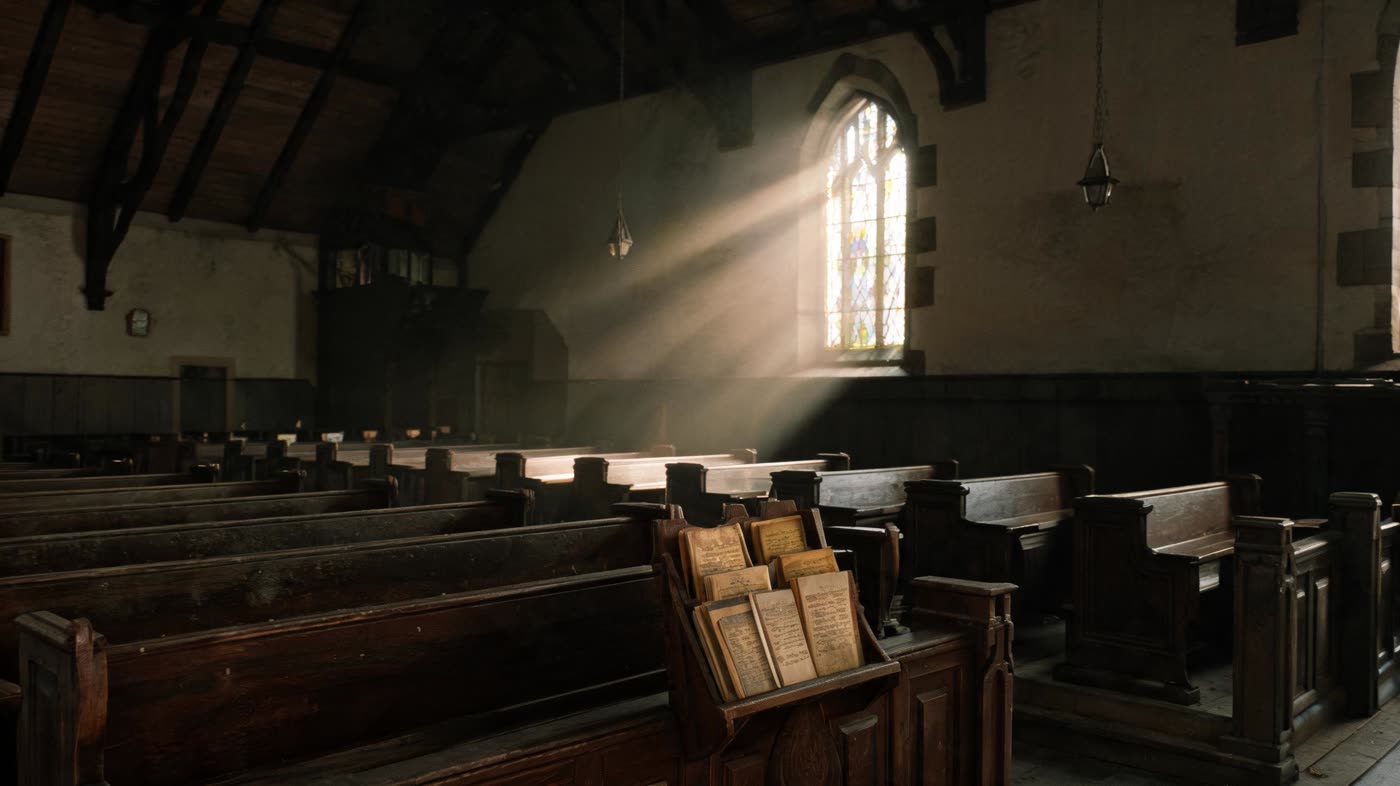
I was seven years old when someone first explained hell to me with enough specificity that I couldn't sleep. I don't remember who it was, a Sunday school teacher probably, or an older kid, or some combination of both, in the way these things tend to happen, one adult starting the architecture and the peer group helping build it. What I remember is the content: fire, forever, no relief, no end, and the deciding factor for whether you went there was whether you had accepted Jesus into your heart before you died. I was seven. I did the math. The math was terrifying.
I said the prayer that night. The sinner's prayer. I said it with my whole seven-year-old heart because I was genuinely terrified, because the alternative had been laid out for me in terms I understood viscerally, and because nobody in that room seemed to think there was anything strange about using the threat of eternal torment to bring a child into a faith system. They were pleased. They called it salvation. I called it the first and most effective threat anyone had ever made against me.
I've been thinking about this lately, as I write songs for the record I'm making, as I sit with the questions that end up being about fear and love and whether I can tell the difference. I want to write about it here because this is something I know a lot of you have lived through too. Not just the specific theology. The specific feeling. The thing that gets built into a child's nervous system when the first big story they're told about the universe is one where infinite punishment is always on the table.
What Fear-Based Belief Actually Does to You
When I say I grew up with fear as the engine of my faith, I want to be specific about what that means because I think people outside evangelical Christianity sometimes imagine it as more abstract than it was. This was not a distant theoretical fear, the kind you feel about car accidents, possible and real but rarely consciously present. This was a daily, textured, integrated fear. The background radiation of my childhood spirituality was: you might be wrong. You might not really believe enough. You might have sinned in a way you haven't confessed. If you die tonight, and the youth group talks were full of stories of kids who died tonight, where would you go?
I re-prayed the sinner's prayer probably four times between ages seven and fourteen. Not out of joy or growth or new understanding. Out of anxiety. Out of the feeling that maybe the last time hadn't quite taken. That my belief wasn't sincere enough, wasn't certain enough, hadn't met the invisible quality threshold. This is called "assurance of salvation" in evangelical circles and the lack of it is a known pastoral problem, so known that there's a whole framework of reassurance that exists to address it. Which, if you think about it, should tell you something about the architecture. When your belief system regularly produces believers who aren't sure they actually believe correctly, the problem is structural.
I was an excellent student of the faith. I read my Bible. I memorized scripture. I was, genuinely, a front-row kid, enthusiastic, engaged, invested. And I was afraid of hell, quietly, persistently, for most of my childhood. Those two things lived side by side. That's the part that's hard to explain to people who weren't inside it: the devotion and the terror were not in opposition. The devotion was partly a management strategy for the terror. The more I knew and prayed and believed, the safer I was. The faith was also the fear was also the faith. It was all one thing.
The Theology of Hell (What I Learned When I Actually Looked)
When I started reading the Bible without the evangelical apologetics filter, and that's a whole story for another post but the short version is: I read it cover to cover as an adult and looked at what it actually said rather than what I'd been told it said, the hell stuff got complicated fast. The English word "hell" in the New Testament translates three different Greek words: Gehenna (a real valley outside Jerusalem used for burning garbage, cited by Jesus in the synoptic gospels), Hades (the general realm of the dead, more like the Greek underworld), and Tartarus (appears once in 2 Peter, referring to where angels are imprisoned). These are not the same place. They are not described with the same characteristics. The conflation of all three into the singular unified concept of eternal conscious torment, fire, forever, the thing I was taught as a child, is a theological construction. A real one, with centuries of development behind it, but a construction nonetheless.
Within Christianity there are actually three distinct doctrinal positions on hell: eternal conscious torment (the one I was taught), annihilationism (the wicked simply cease to exist), and universal reconciliation (everyone is eventually restored). All three have serious theological defenders. All three can cite scripture. The version most commonly deployed to frighten children, the vivid specific eternal torture version, is one position in a contested theological debate, presented to me as the only position and as inarguable fact. That's a misrepresentation. A significant one.
I also want to note, because it matters to me: Jesus, in the actual gospel texts, talks about Gehenna most often in the context of social ethics, what you do to the poor, how you treat the vulnerable, how your external religiosity lines up with your internal character. The bulk of the hell-adjacent language in the gospels is aimed at religious hypocrites and at the wealthy who hoard resources while others starve. This is not the same target audience that I was taught was the primary concern. I was taught that my personal salvific status was the main event. The gospel texts suggest something with a much heavier social-justice orientation, which is charming, given what American evangelicalism has become politically.
Unlearning Terror (The Slow Work)
The process of unlearning fear-based belief is genuinely strange because you can't just argue yourself out of something that lives in your nervous system. I spent years, after I stopped believing, after I walked away, still having moments of what I can only describe as hell-anxiety. The old circuitry firing. You're doing something the church would have considered sinful and some part of the brain that got wired at age seven throws up a spike of dread. Not a thought, exactly. A feeling. A body-level alarm with no conscious content, just residual fear shaped like something infinite and hot.
I talked to a therapist about it, which I'd recommend to anyone processing religious trauma because it is genuinely useful to have someone help you disentangle the developmental psychology from the theology. What she helped me see was that the fear-based faith wiring is not about God at all, really. It's about control. It's about a child learning that the world is safe or unsafe based on whether they're performing correctly. The specific religious content is almost incidental, the same circuitry can be built by a lot of different threatening inputs. What I'd been given was a particularly durable version because it reached for infinity to make its threat. You could make a mistake that lasts forever. That's a heavy weight for a seven-year-old's nervous system to carry.
The unlearning has been slow. It's still going. What I've found, on the other side of active religious terror, is something much quieter. Not belief exactly, not certainty in any direction, but a kind of groundedness in what I actually experience and value that doesn't require the threat architecture to hold it together. I don't need hell to be good to people. I don't need eternal punishment to motivate ethical behavior. I need to care about the people in front of me and act like their wellbeing matters. That's it. That turns out to be enough.
Why Fear Isn't Love (And Why This Matters)
There's a verse in 1 John 4:18 that I find interesting, given all of this: "There is no fear in love; but perfect love casts out fear, because fear involves punishment, and the one who fears is not perfected in love." This is in the same Bible. Same tradition. The same text that elsewhere describes the threat of hell also says, explicitly, that fear involves punishment and is incompatible with love.
I have never been given a satisfying explanation of how to hold those two things together. The standard apologetic response is something about appropriate fear and reverence versus the fear of someone who hasn't truly accepted the gospel, which is a reading, but it's a convenient one that lets the hell-threat stay while also citing the love-verse whenever it's useful. What I see when I read 1 John 4:18 without the apologetics filter is a strand of the tradition that understood, at some level, that building a faith on punishment and threat is fundamentally at odds with building one on love. The contradiction is in the text. It's been there the whole time.
I don't write about this stuff to be cruel to the people who still believe it. My problem has never been with ordinary believers. The people in the pews who were sold the same terrifying story I was and are doing their best with it, I know those people. I love some of them. My problem is with the systems that profit from the terror. The churches and the institutions and the political movements that have found the hell-threat to be a useful tool for producing obedience and keeping people inside the boundary. That's not pastoral care. That's management. And there's a song I'm writing about it right now, late at night, in a closet-sized studio, trying to say what took me decades to understand in a way that fits inside three and a half minutes.
Fear isn't love. The threat isn't the invitation. And a seven-year-old deserved better than an infinite punishment as their introduction to the universe. So did you, if you were that kid. I see you. We're out here.