Since HEATHEN HYMNS came out, I've been getting a specific kind of comment. Not often, but often enough that I need to address it directly. It shows up in a few different wordings. "You were never a real Christian." "You just had bad theology." "A true believer doesn't walk away." "If you'd actually understood the faith you wouldn't have left it."
I want to be clear about a few things before I get into this, because I've said it before and I'll say it again: my problem is the pulpit, not the pew. I'm not writing this to attack anyone who currently believes. I'm writing it because the "you were never really a believer" argument is the specific dismissal that most needs a real answer, and I have one, and it's going to take a minute to lay out properly.
The answer is: I was the front-row girl. And I read everything. That is exactly how I got here.
What "front-row girl" actually means
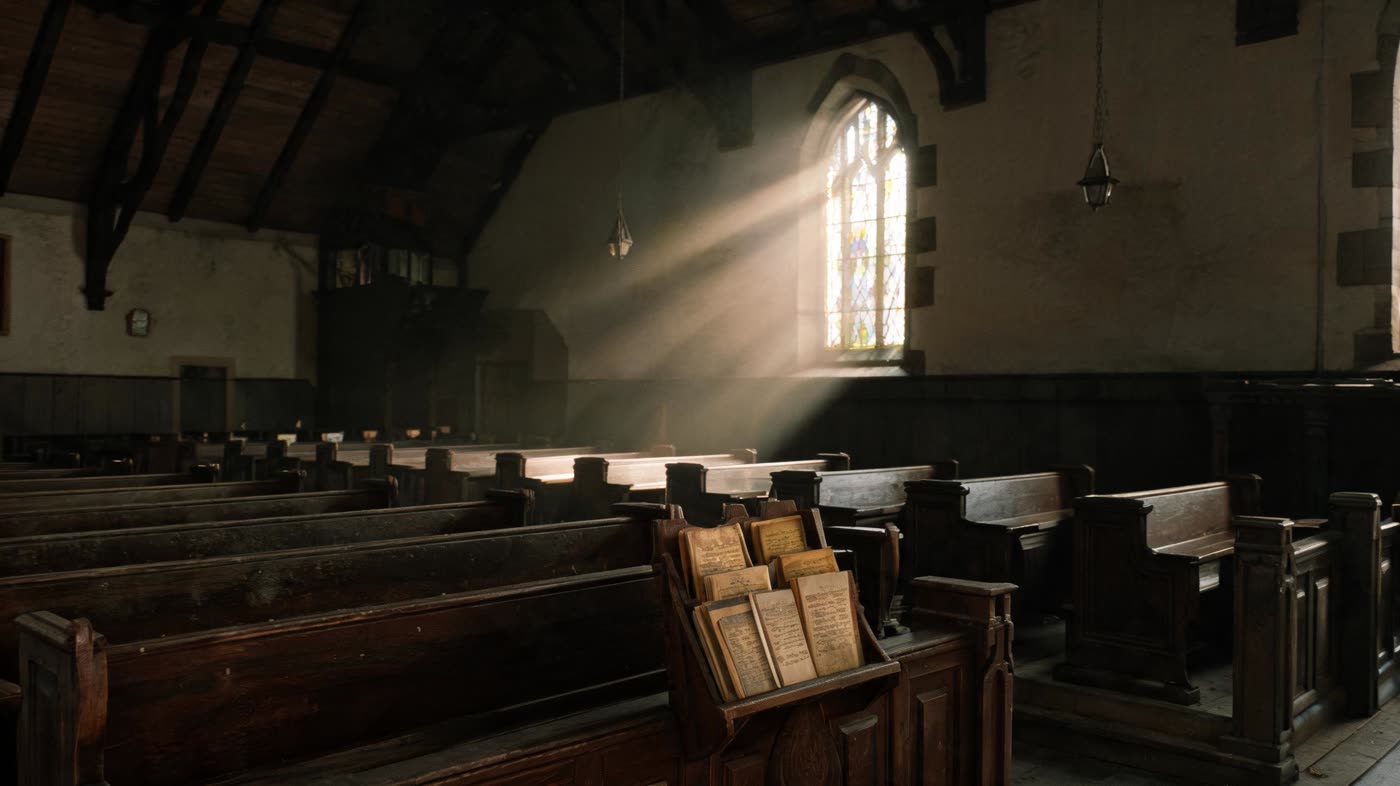
I grew up in a small Southern town in an evangelical church. Not casual evangelical, committed, serious, engaged evangelical. Sunday morning, Sunday evening, Wednesday night. Vacation Bible School in summer. Youth group in winter. The church camp where we sang until we cried and meant every word of it, or I thought I did. My Bible wasn't decorative. It was underlined. It had tabs. I had notebooks full of sermon notes from the time I was twelve years old. I memorized passages. I did the devotionals. I prayed daily and believed those prayers were heard.
I was the girl in the front row not metaphorically but literally. I chose the front. I wanted to be close to it. The music and the teaching and the community, these things weren't performances I was going through. They were the architecture of my life. When I sang in worship I was not producing sounds with my mouth while thinking about something else. I was doing the thing. I was in it. That faith was mine and I carried it with my whole body.
So the "you were never really a believer" framing is not just wrong. It's a specific kind of wrong that I need you to sit with for a second. It's the retroactive rewrite. The argument is: since you ended up here, the earlier version of you must have been fake or deficient. But I was there. I know what I experienced. You don't get to tell me what was happening inside me when I was seventeen and crying in the front row because I felt the presence of something I believed was God. That was real. The experience was real. What it was an experience OF, that's what changed.
the reading that changed everything
Here's what I actually did. In my mid-twenties, after I'd been drifting from practice for a while, not from belief, just from the habit of church, I decided to read the Bible cover to cover without the apologetics filter. Not with a study Bible full of explanatory notes. Not with a pastor's guidance. Not with the devotional framing I'd been trained in. Just the text. Start to finish.
What I found was not the book I had been taught. Not entirely.
I knew the passages that got emphasized: John 3:16, the Sermon on the Mount, Psalm 23, the Resurrection narratives. I knew those cold. But reading straight through, you also encounter the full text of Numbers 31, where Moses instructs his soldiers to kill the captured Midianite boys and all the non-virgin women, and to keep the virgin girls for themselves. You read 1 Samuel 15, where God commands Saul to kill every Amalekite, man, woman, child, infant, ox, sheep, camel, donkey. Every living thing. Saul is condemned not for the massacre but for keeping some of the animals alive. Deuteronomy 22:28-29, where a man who rapes a virgin must pay her father fifty shekels and marry her. She has no recourse. Judges 19, where a woman is handed to a mob, gang-raped, and left for dead, and the story proceeds without once noting that what happened to her was a horror in itself, she is merely a narrative device.
I read the genealogies of Jesus in Matthew 1 and Luke 3 that contradict each other. I read the two different creation accounts in Genesis 1 and Genesis 2 and noticed they don't agree on the order of creation. I read 2 Samuel 24, where God incites David to take a census, and 1 Chronicles 21, where it's Satan who incites him, same story, different agent. I read the accounts of Judas's death in Matthew 27:5 (he hanged himself) and Acts 1:18 (he fell headlong and burst open in a field) and noticed these cannot both be accurate. I read the plagues in Exodus 7-11 and kept track of how many times God explicitly hardened Pharaoh's heart, making it impossible for Pharaoh to comply, and then punished Egypt for Pharaoh's non-compliance.
I am not listing these to perform atheist gotcha-ism. I'm listing them because when I read them, as a sincere believer with a well-worn Bible, they created in me a cognitive crisis that I could not resolve by praying harder. They required real engagement. And the real engagement, the actual intellectual honest engagement with what the text says, took me somewhere the apologetics-trained version of my faith couldn't follow.
Deconstruction is not rebellion. It is the opposite.
The narrative that deconstruction is rebellion, that people leave faith because they want to sin, because they're seduced by the world, because they didn't try hard enough or pray hard enough or believe earnestly enough, is a narrative that serves institutions, not truth. It is a way of explaining away doubt without actually answering it. If the questioner is the problem, you never have to engage the question.
My deconstruction was not rebellion. It was the most serious application of the intellectual virtues I'd been taught in church, honesty, rigor, willingness to follow the truth wherever it leads, applied to the claims of the faith itself. I took it seriously. I took it more seriously than I'd ever taken it when I was just accepting the framework. I went back to primary sources. I read the scholars, both the apologetics side and the critical scholars. I sat with the contradictions instead of resolving them through motivated reasoning. I followed the evidence.
That's what honesty looks like when you take faith seriously. Not compliance. Engagement.
The faith tradition I grew up in told me that the truth was not afraid of scrutiny. That I should love God with all my mind, not just my heart. I took that seriously. The result was not what my church expected, but I was using exactly the tools they gave me.
what I grieve and what I don't
I miss the community. I want to be precise about that because I want to be honest: I miss the specific warmth of people who share a framework for meaning, who show up for each other in crisis because that's what the faith demands, who sing together and mean it. That is real and it is good and I lost it and the grief is genuine.
I miss the language. Christianity has a profound vocabulary for interiority, for grace, for suffering, for transformation. I still use it sometimes because no other language quite fits. "Amazing grace" lands differently than "I was in a bad place and then things got better." The religious language is doing something the secular one can't always do. I mourn not being inside it the way I used to be.
I do not miss the shame. I do not miss the body policing and the purity culture and the thing where my bisexuality was something to be prayed away or hidden. I do not miss the way political loyalty to specific power structures got baptized as God's will. I do not miss the managed ignorance, the careful curating of which questions were allowed, that I participated in and that I now understand as an engine of compliance, not a shelter for souls.
I write this stuff and make this music because I believe naming the real thing matters. Because there are people right now in the exact seat I occupied, asking the questions I couldn't voice, and they need to know they're not crazy and they're not deficient and they're not secretly never-real-believers. they're just honest. And honesty sometimes takes you places nobody prepared you for.
I want to say something specific to the people who send me the "you were never a real believer" argument, because I think most of them are saying it out of a real need: the need for their own faith to be coherent. If I was a real believer and I left, then leaving is something that can happen to real believers. That's scary. Easier if I was always fake, always deficient, always missing something that makes a real believer stay. I understand that need. I spent years having the same argument with myself, maybe if I just believed harder, prayed more sincerely, fixed whatever was wrong with my faith, I could get back to where I was. The argument is a way of keeping the door closed. I'm not mad at the people making it. I just can't accept its premise, because the premise is factually wrong about my history.
The question underneath all of it, underneath the accusation and the defense and the whole exhausting back-and-forth, is whether faith is compatible with honest inquiry. My former church would say yes, in theory. In practice, the inquiry was supposed to be bounded. You were supposed to read the apologetics, not the critics. You were supposed to study the faith's own explanations of itself, not go looking for contradictions on your own. Loving God with your mind meant studying the things that confirmed what you already believed. When I took the principle seriously and applied it to the whole text, without the apologetics guardrails, I ended up somewhere nobody had planned for. That's not deficiency. That's the principle working exactly as described.
You were real. Your faith was real. What you're doing is real. It's the hardest and most honest thing a former true believer can do.
The record knows. Come find it if you need to.