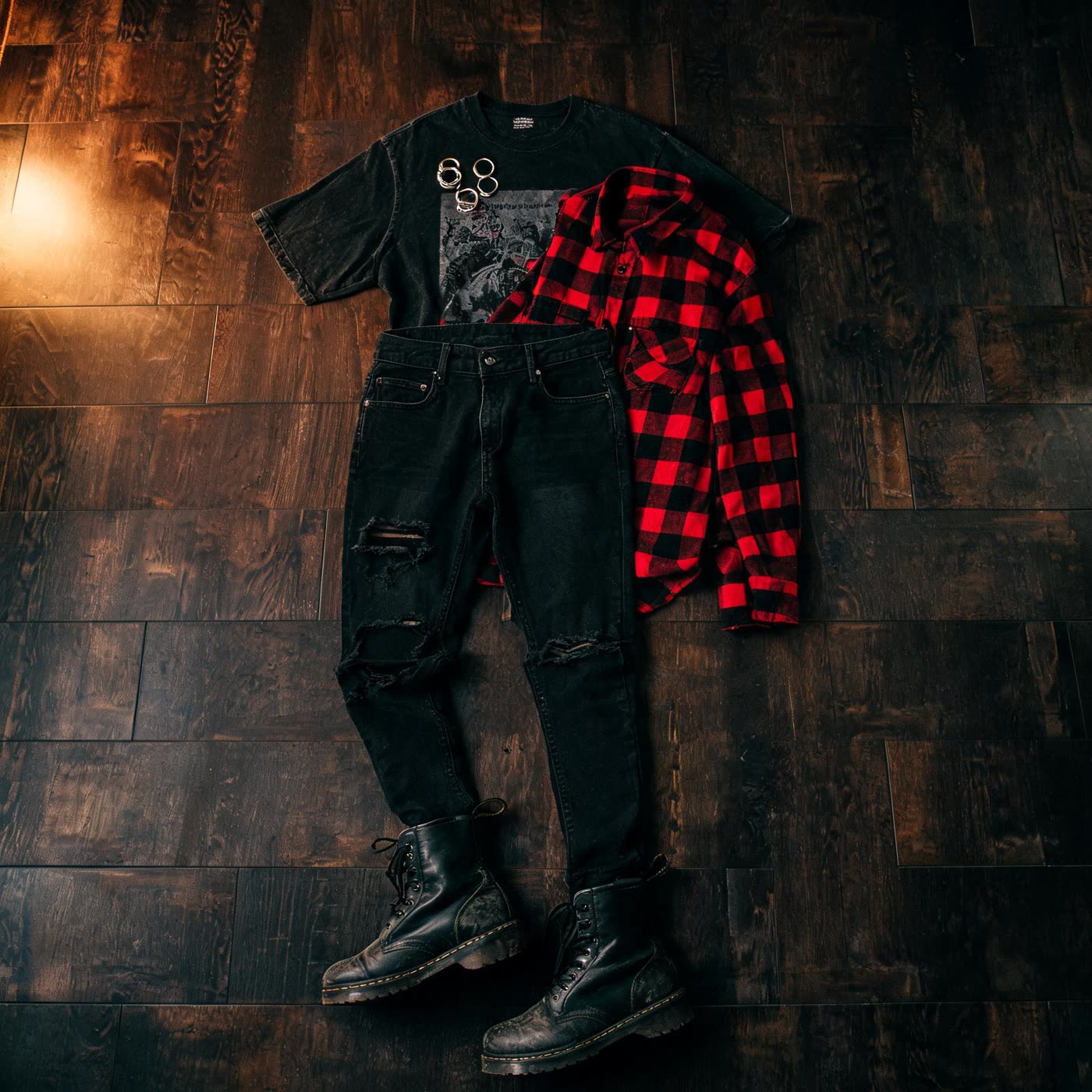
The "comfy fit" trend has been all over TikTok and I want to write about it because I have opinions that go past "yes, soft pants are good." I'm in. I wear oversized flannels and worn-in boots and jeans that have been washed so many times they've softened into something like a second skin. My studio corner has a pile of hoodies that I rotate through based on which one I can find first in the dark at 1 a.m. I am, aesthetically, a comfy-fit person. Have been for years. And I think there's something more going on in the popularity of this conversation than just a collective exhale about pants with an elastic waistband.
Let me tell you what I think is actually happening when someone posts their comfy fit and it gets a hundred thousand likes from people who felt SEEN by an oversized crewneck and some wide-leg jeans. Because I don't think it's just about the fabric. I think it's about whose eyes you're dressing for. And that question has more history and more weight than it might look like from the outside.
The Economy of Being Looked At
We live inside a system that has, for most of recorded history, organized women's and femme people's relationship to their bodies around the concept of being seen and evaluated. This is not a hot take. The history of women's fashion is, in significant part, a history of garments designed not for the wearer's comfort or self-expression but for the management of other people's perception. Corsets. Heels. The structural requirements of formal dress that make sitting, moving, and breathing into negotiated activities. The endless adjustment of hemlines and necklines to some always-shifting ideal of appropriate visibility.
The church I grew up in had its own version of this, aggressively codified: what you wore was a statement about your values, your modesty, your respect for the men around you who might be tempted by the wrong garment. I've written about purity culture before and I don't want to retread all of it here, but I want to name that the modesty framework was, at its core, the same system with a different aesthetic. It was still organizing women's appearance around male response. Whether the instruction is "be appealing enough" or "be modest enough," the frame is the same: your body is a visual object and its management is a moral responsibility owed to external evaluators. Both are wrong. Both are exhausting. Both have nothing to do with what you actually want to wear when you roll out of bed at 7 a.m. to make coffee in your studio apartment.
The comfy fit, in this context, is a refusal. Not a dramatic one necessarily, you can decline to perform a social expectation without making it a protest, just by doing the thing you actually want to do, but a refusal nonetheless. When someone posts their soft pants and their worn flannel and their hair in a clip and says "this is what I look like today," they are opting out of the framework that says getting dressed is primarily a service rendered to observers. They're saying: I put this on because it felt good on my body. That's it. That's the whole reason. Judge it if you want, the judgment isn't load-bearing to the outfit's existence.
Comfort Is Not Laziness (Let Me Say That Louder)
Something bothers me about the way "comfy fit" gets discussed, including, sometimes, within the comfy fit community itself: the apologetic framing. The "I know I look like I don't care but..." The "today was a soft day" with the implicit acknowledgment that a soft day is the exception, a low bar, a concession to weakness. As if comfort is a guilty pleasure rather than a legitimate priority. As if dressing for your body's actual experience is somehow less valid than dressing for the visual experience of someone looking at you from the outside.
I refuse the apology. I have been wearing oversized flannels and secondhand boots and jeans that fit like they were made for my specific slouch for years now and the periods when I've been most creative and most productive have been the periods when I've been most physically comfortable in my clothes. This is not a coincidence. When your body isn't managing the discomfort of a garment, the pinching, the restricting, the constant micro-adjustment, the awareness of a waistband cutting into you when you lean forward, your brain has more available for the things you're actually doing. That is a physiological reality. You can be comfortable and competent and put-together and all the other things. You can be comfortable and also wildly overdressed for the occasion. Comfort and style are not in opposition. The false choice between them is sold to us by an industry that profits from the gap.
Also: the idea that effort equals worth, that getting dressed in something uncomfortable is a form of respect toward whoever you're seeing, that showing up in soft pants is a form of disrespect, is one of the more effective status management tools the fashion-industrial complex has produced. It keeps discomfort as a signal of investment and comfort as a signal of not caring. That's backwards. Not caring what you look like to others is not the same as not caring about yourself. In fact, caring enough about your own experience to prioritize your body's comfort over external validation is a form of self-regard that the "you should look put-together" framework would rather you didn't develop. It's harder to sell you things if you already feel fine.
What I Actually Wear (The Honest Version)
Since we're here: let me be specific about my comfy-fit aesthetic because I think it's useful to get past the abstract and into the actual.
For the studio and the day-to-day: oversized flannels in every pattern and weight, most of them secondhand because they're already soft. Wide-leg jeans or straight-leg denim that doesn't grip. Thermal underlayers when it's December and my apartment's heating situation is "aspirational." Worn boots, I have two pairs I've had for years that have shaped themselves to my feet, for anything that requires actual shoes. I wear my tattoos as their own accessory, they're on my skin year-round regardless of what I put over them. My hair is usually either fully down or fully up in something functional. I don't spend thirty minutes on it. I have a record to make.
For shows and performances: this is where it gets interesting because the comfy fit philosophy doesn't mean the same thing on stage as it does in the studio. On stage I want to look like myself but more, more intentional, more specifically myself, like a concentrated version of the aesthetic. For me that means the same base elements, denim, boots, black tops, but chosen more deliberately, layered with more intention. Maybe a jacket I love. Maybe specific boots. The key is still: does this let me move? Will I still be able to play hard in this for two hours? Will I still recognize myself in stage photos? The last thing I want is to look on stage like I'm wearing a costume of some imaginary version of what a female rock artist is supposed to look like. I want to look like me. The comfy fit ethos carries over because it's always fundamentally about wearing YOUR body, not a performance of body.
dressing for yourself in practice
The practical philosophy I've landed on, after years of experimenting and also years of being told explicitly and implicitly what I should look like: I ask my body first. Before I ask "does this look good," before I ask "does this fit the occasion," before I ask any question that involves someone else's hypothetical eyes, I ask: how does this feel? Is it comfortable? Does it let me move? Does it feel like me?
If the answer to those questions is yes, then the "does it look good" question becomes secondary and much easier to answer, because clothes that actually fit and feel good and are in your genuine aesthetic look good. Not to everyone, necessarily. Not to any imaginary evaluator. But they look like you. And looking like yourself is the only standard that's actually in your control and the only one that, over the long run, you can actually build a consistent relationship with your appearance around.
The comfy fit trend is telling me that a lot of people are hungry for permission to make this shift, to put their own comfort and self-expression first and stop organizing their dressing around the production of a specific impression. I think that's worth celebrating, not apologizing for. It's December. The light is going fast and it's cold and the year has been a lot. Wear the soft pants. Put on the flannel that's been washed forty times and has a small paint stain on the cuff that you're keeping as a feature. Make the coffee. Sit in your secondhand chair and feel comfortable in your own skin and in your own house and let that be enough.
You are not a garment. You don't exist to be worn well for someone else's benefit. Dress for yourself. That's the whole manifesto. I love you all.