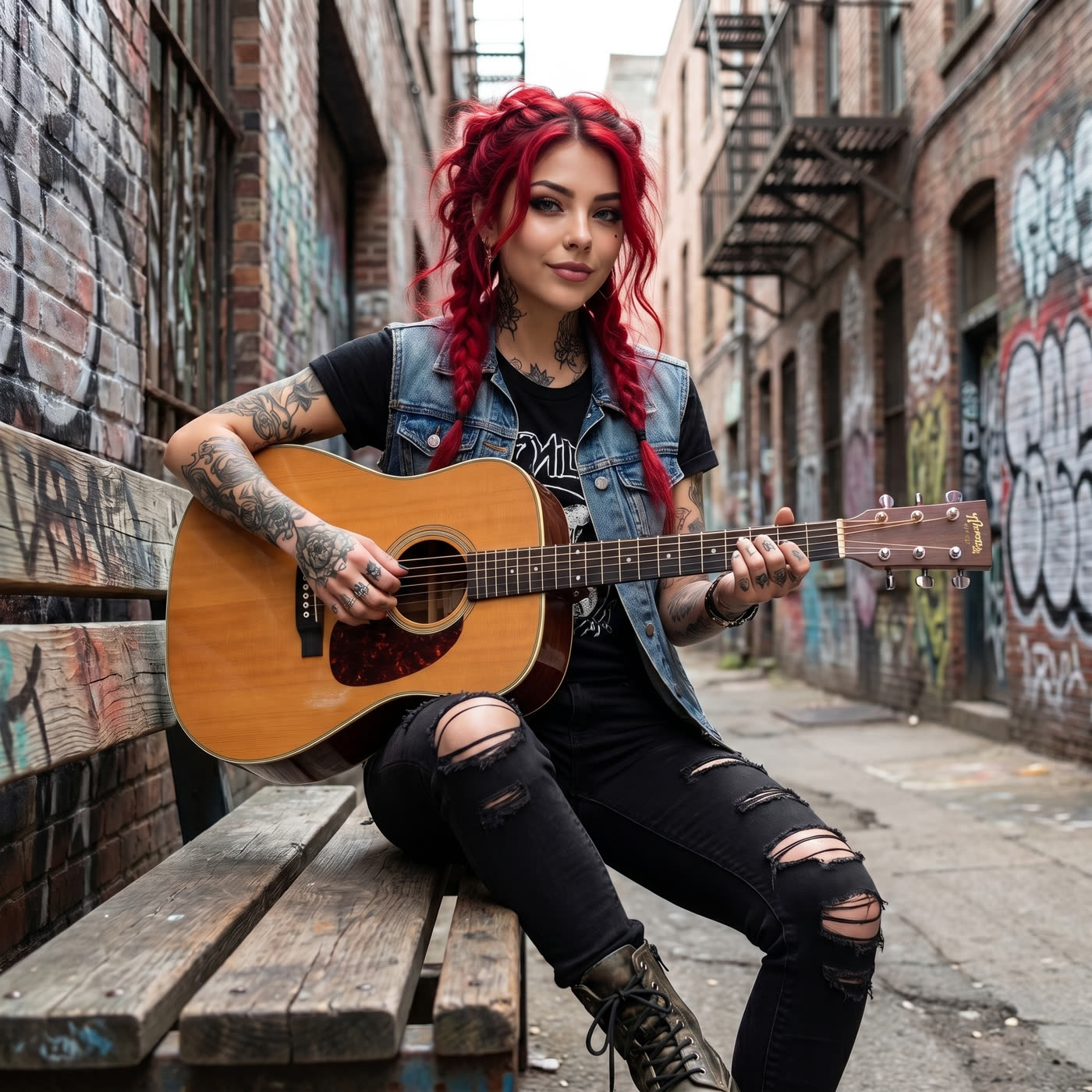
The "eyes filter" trend has been everywhere lately, that filter that enlarges your eyes, brightens them, gives you those anime-adjacent proportions that look a little uncanny but also somehow really compelling. You've probably seen it. You may have used it. I've played with it in a couple of TikToks because that's part of what I do on this platform and then I've been thinking about it for three weeks in the way I think about things that bother me in ways I can't immediately articulate.
Here's what I landed on: the eyes filter is doing something more subtle and more corrosive than most of the obviously dramatic filters, precisely because it's subtle. It doesn't give you a whole new face. It just makes your current face... slightly better according to a specific aesthetic ideal. Larger eyes, clearer eyes, brighter eyes. And the insidious part is that because the edit is small, it's easy to habituate to. You start to look at your filtered self and that becomes the reference point. And then you look at yourself without the filter and something is wrong, something is off, and the thing that's "wrong" is that you look like yourself.
That bothered me. It bothered me enough to write about it, and to post some stuff about it on TikTok, and to get a really interesting comment section that confirmed I'm not alone in noticing this.
What Beauty Filters Are Actually Doing to Your Self-Image
I want to be real with you: I am not immune to this. I have looked at myself in a filter and felt better about what I saw, and then looked at myself without a filter and felt the absence. That's the trick. It's not that the filter makes you feel great. It's that the filter changes your baseline so that your natural face feels like less. And that feeling of less is manufactured. It was put there by a tool that was not designed with your wellbeing as its primary goal. It was designed to get you to use the filter more, to spend more time on the platform, to post more content. The improvement in how you feel about your face is a feature. The degradation of how you feel about your real face is a side effect that the business model is comfortable with.
The specific eye stuff hits me differently than some other filters because eyes are so much about identity and recognition. Your eyes are one of the primary ways people recognize you, read your emotions, connect with you. My eyes are a specific shape and color and they have a specific way of looking at things that is recognizable if you know me, slightly too direct, a little like I'm always evaluating something. that's mine. It's in my face when I perform, when I'm doing press, when I'm posting, when I'm sitting across from a friend at dinner. The filter changes the geometry of the thing that carries my expressiveness, and the changed version is prettier by one metric and less mine by every other metric.
I've been doing a lot of press during this HEATHEN HYMNS rollout, more photos and videos in the past few months than in the whole prior year combined, and I've had to make active choices about filters. My choice is: none for the real stuff. No filters on the photos that represent me to people who are going to come to a show and actually see my face in person. Because the deal with filters is that they create a gap between your digital self and your physical self, and that gap is a setup for a specific kind of disappointment and disorientation that I don't want to be part of causing in anyone who cares about my music. You find my songs, you feel something, you come see me perform, and I want you to see me, not a version of me that never existed except on a phone screen.
The Part About Purity Culture (Stay With Me)
This connects to something deeper that I keep coming back to, and I know I draw this connection a lot but it keeps being relevant: purity culture taught me that my body was both a temple and a liability. It had to be maintained and contained. Too much was bad. Not enough was bad. There was a narrow range of acceptable physical presentation that was modest but not careless, attractive enough not to be a source of shame but not so attractive as to be a source of temptation. My body's appearance had constant moral weight attached to it.
That background made it particularly hard for me to develop a straightforward, uncomplicated relationship with my own face. Because faces, like bodies, had loaded meaning. How you looked was part of how you were evaluated as a person. And that evaluation was external, constant, and tied to things that were supposedly about your character but were actually just about compliance with a specific aesthetic ideal.
Beauty filter culture has a different vocabulary and a different set of institutions behind it, but the mechanism is the same: your face has a specific correct version, and the current version is not quite it, and here is a tool to get you closer. The tool is free to use because you pay in something else, your sense of your own face as adequate on its own terms. I've noticed that the more filter content I consume, the more I drift toward discomfort with my own face when I see it unedited. And the less I consume, the more I feel like my face is just my face, which is a thing that has history and character and belongs to me and is fine.
So I have to manage my filter content consumption as part of managing my overall relationship with my own appearance. That's not a small thing. It requires ongoing attention. But it's worth it, because I need to be able to look at my face with something close to neutrality, and that neutrality is incompatible with a steady diet of the gap between my face and a filtered version of my face.
What My Real Face Actually Contains
Here's what I've been trying to hold onto, specifically during this weird rollout period when my face is on more things than usual and I have more opportunity to critique it. My real face has a scar from a bike crash when I was nine that cuts through my left eyebrow. My real face has the particular texture of someone who spent her early twenties crying and laughing a lot in roughly equal measure. My real eyes have the color they have because of genes from people I'll never meet. My face moves in specific ways when I'm surprised or amused or angry that people who've watched me perform can recognize, that is relationship data, encoded in my face, and filters don't represent it correctly.
The filter version of my face is prettier by the current metric. It would photograph better. It would read as more conventionally attractive to a wider range of people. But it would also be less TRUE, and truth is the whole value proposition I'm working with. The songs are true. The posts are true. The interviews are true. My face is going to have to be true too, because I can't maintain the fiction that the filtered version is me and also be asking you to trust me with the real stuff. That's an inconsistency I can't live inside.
I'm not saying you have to make the same choice. I'm not saying there's something wrong with you for using filters, for enjoying the way you look in them, for preferring them for certain kinds of content. This is not a shame post. This is a process post, me working through something that took up real estate in my brain and coming out with a position that makes sense for me specifically.
The Larger Picture
The eyes filter is a small thing in isolation. But it exists inside a content ecosystem that has, over the last several years, dramatically shifted what people's expectations are for faces on screens. We've collectively habituated to a level of digital enhancement that would have seemed extraordinary even a decade ago, and we've done it gradually enough that we didn't really notice the shift. Most professional content, much of what we see in media, marketing, social media, is filtered or retouched in some form. The unedited face is now the outlier.
That's worth naming clearly because it's easy to mistake a manufactured norm for a natural one. Your face is not failing to meet a standard that faces naturally meet. Your face is measuring itself against a standard that was created by software. Those are different things. The standard is not neutral. The standard has an economic interest in you feeling the gap.
Notice the gap. Then decide how you want to relate to it. That's all I've got. Your face is yours and it is enough. I love you.