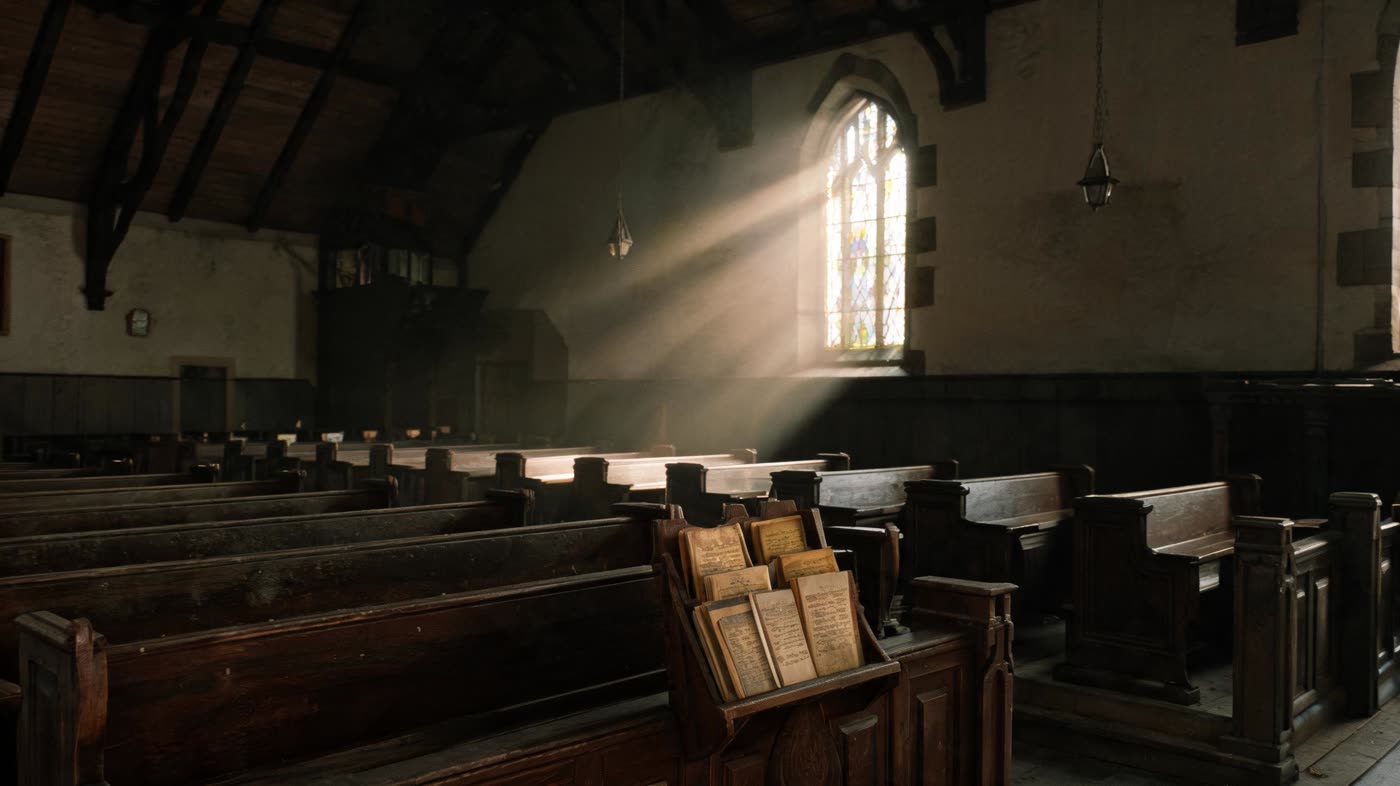
The copy I used was my grandmother's. Burgundy leather, her name embossed in gold on the cover, margins full of her handwriting in that careful Palmer-method cursive you don't see anymore. I inherited it when she died. I kept it on a shelf for six years. When I finally opened it, not for a devotional, not for a church assignment, but to actually READ it, I had to set her notes aside in my head and just look at the text. That felt like a small betrayal. I did it anyway.
I'm telling you this because I want you to understand what I'm NOT. I'm not some smug guy with a podcast who read a Wikipedia summary and decided religion is for idiots. I was a front-row girl. Vacation Bible School, youth group, mission trips, the whole architecture. I memorized verses for gold stars. I cried at retreats. I meant it. Which is exactly why reading it all the way through, slowly, with fresh eyes and no pastor filling in the gaps in real time, was the most disorienting experience of my adult life.
This is the story of that year. The whole thing. Because it's the thing everything else I write about comes back to and I think it's time I wrote it down properly.
what I expected vs. what I found in Genesis
I started, like you do, at the beginning. And within two chapters I had a problem. Genesis 1 gives you the order of creation: light, sky, water, land, plants, stars, animals, then humans, male and female, simultaneously, in God's image (Genesis 1:27). That's the poem. That's the one everyone knows. Beautiful, orderly, cosmic.
Then Genesis 2 starts, and it tells a completely different creation story. Different order: man is formed first, from dust (Genesis 2:7). THEN the garden. THEN God decides man is lonely and makes animals from the ground, same material as man, and man names them but none are a suitable partner. THEN God takes a rib and makes woman. Two different accounts, two different orders, two different tones. One is poetry, one is a kind of primitive mythology with God as a craftsman.
I'd sat through decades of sermons. Nobody ever said: these are two different sources woven together. Nobody said: scholars have known this for centuries, it's called the Documentary Hypothesis, it's not a secret. They just... didn't mention the discrepancy. And when I saw it, unmissable, right there in the first two chapters, I didn't feel angry yet. I felt confused. I thought maybe I was missing something. I wrote it in the margin in pencil and kept reading.
The pencil marks accumulated fast.
Numbers, Samuel, and the violence I was never assigned
Look. I've written about Numbers 31 in another post and I'll only summarize here: God, through Moses, commands the Israelite army to kill every Midianite man, every male child, and every woman who is not a virgin. The virgins, "young girls who have not known a man," are to be kept for themselves. It's in the text. Numbers 31:17-18. Go look.
I'd been in church my whole life and nobody had assigned Numbers 31. Not once. The Sunday school lesson I remember is the one where the Israelites defeat the Midianites, full stop, enemy vanquished, God wins. The details were just, not there. The curriculum had quietly edited them out.
First Samuel 15 is where God commands Saul to "utterly destroy" the Amalekites, "men and women, children and infants, cattle and sheep, camels and donkeys" (1 Samuel 15:3). ALL of them. And then Saul spares the king and some animals, and God is SO ANGRY that he rejects Saul as king. The sin is not the massacre. The sin is the incomplete massacre. Samuel then hacks the captured king Agag to pieces "before the LORD" (1 Samuel 15:33).
I sat with that for a long time. I tried the apologetics moves I'd been trained in: God's ways are higher than our ways (Isaiah 55:8-9). These were different times. God was establishing a holy people. I knew all the outs. And I'd used them before, reflexively, whenever a skeptic brought something like this up. But reading it myself, slowly, without a pastor smoothing it over, the outs started to feel like what they were. Exits from the text, not entrances into it.
the contradictions that broke through
The violence was one thing. The contradictions were another and in some ways hit harder, because the contradictions aren't about God being frightening. They're about the text being human. Made by humans. Assembled by humans. Revised by humans.
Here's one that stopped me cold: in 2 Samuel 24, God is angry at Israel and incites David to take a census. "And again the anger of the LORD was kindled against Israel, and he incited David against them, saying, Go, number Israel and Judah." God incites David. Then David takes the census and God punishes David, and the people, for taking the census. The same God who told him to do it.
The parallel account in 1 Chronicles 21 clearly bothered whoever wrote Chronicles too, because in that version it's not God who incites David. It's Satan. The scribes changed it. Same story, different villain. You can see the editorial anxiety in real time across two books of the same Bible.
Or the death of Judas: Matthew 27:5 says Judas "went away and hanged himself." Acts 1:18 says Judas "falling headlong, he burst open in the middle and all his intestines gushed out," and that he bought a field with the blood money himself, whereas in Matthew it's the chief priests who buy it. These are not the same story told from different angles. They are different stories with different facts. Both are in the canon. Nobody edited one of them out.
I wrote down every one of these and I stopped defending them. That was the shift. I stopped going to the apologetics toolbox and I just let the text say what it said. That's when the year got hard.
what the read-through actually cost
I want to be careful here because I've been accused in comments, in DMs from strangers angrier than me, of doing this for clout. Of playing up the drama. So let me tell you what it actually felt like, which was not dramatic. It was quiet. It was slow. It was like watching a painting you've loved your whole life and gradually noticing the brushstrokes don't resolve into the thing you thought they were painting.
The grief came later and it came in waves. I've written about that. What came during was something more like disorientation, the specific vertigo of having your oldest map fail. I'd organized so much of my interior life around this document. My sense of meaning, my guilt, my framework for what love was supposed to look like, my understanding of why suffering existed. And the document kept insisting on being more complicated than I needed it to be.
By the time I got to the New Testament, I was reading differently. I wasn't looking for ammunition, I want to be clear about that, because the "gotcha atheist" thing is not interesting to me. I was looking for the parts that still rang true. And some of them do. The Sermon on the Mount is extraordinary. "Blessed are the peacemakers." "Love your enemies." The parts about caring for the poor, the outcast, the stranger, those parts are genuinely beautiful. I still think they're beautiful. I wrote that in the margin too.
But beautiful ideas don't require a supernatural author to be worth following. That was the thing I kept arriving at. The good parts were good on their own merits. The troubling parts didn't get smoothed over by the good parts. They just coexisted the way everything human coexists, the magnificent and the monstrous, right there in the same binding.
where I landed, and why I write songs about it
I finished the read-through on a Tuesday night in January. wait, it might have been Wednesday. doesn't matter. I remember cold coffee and the apartment was very quiet and Lazarus, my pothos, mid-recovery from one of his near-death experiences, was catching the streetlight on the windowsill. I closed the Bible and sat there for a while.
I didn't feel triumphant. Not liberated, not exactly, not yet. I felt like someone who'd just had a very long very honest conversation with someone they'd loved, and at the end of it realized the relationship had been built on a shared story that one of them didn't believe in anymore. It's a specific kind of sad. If you've been there, you know.
The album I'm currently working on, the record I've been wrestling with for the better part of this year, is my attempt to put that somewhere. Not to convert anyone. Not to perform my atheism for an audience. Just to make a document of what it felt like from the inside: the faith that was real, the reading that was honest, the grief that followed, and the weird tentative thing that's been growing in the space it left. I don't have a clean name for that thing yet. I'm writing songs to find out what it is.
What I know is this: my problem was never with the people in the pews. My grandmother, whose notes are all through that Bible I read, was one of the most genuinely good people I've ever known. Her faith was real and her love was real and I don't need to unsay any of that. My problem is with the apparatus that decided ordinary people like her didn't need to know what was actually in the text they were building their lives on. That's the thing I'm angry about. The curation. The managed encounter with a document that's been managed for so long that most people have never actually read it.
Read it. I mean that. If you're a believer, read the whole thing, not the guided tour, not the highlight reel. Read Numbers. Read Judges 19. Read Deuteronomy 22. And then figure out what you actually believe, on your own terms, with your own eyes. Whatever you land on, I'll respect it. I just want you to land there yourself.
That's all I've got. The record's not done yet. But it will be.