Full transparency: I went down a TikTok photo trends rabbit hole in the context of the album rollout. I needed more content, I didn't have a photographer on call, and a dozen different trend-based shoots seemed like a reasonable DIY solution. Some of them were. Some were an object lesson in my own limitations. All of them taught me something, which is more than you can say for most things I do at midnight.
The "TikTok photo trends" search is full of tutorials, specific lighting setups, poses, framing tricks, and aesthetic styles that have gone viral enough to have names and documented methods. I am an indie artist on a budget, not a fashion photographer. My resources were: my phone, one ring light, the natural light from my apartment windows at two different times of day, Lazarus the pothos (who is decorative when he's cooperating), the brick wall on the side of my building, and my own face, which is tattooed and red-haired and pretty much looks like what it looks like.
I attempted seven trends. I'm ranking them honestly.
The ones that actually worked
The window-light portrait trend, where you position yourself facing a large window for soft, even natural light, worked immediately and almost embarrassingly well. The key, which multiple tutorials confirmed, is facing the window directly rather than standing beside it. Side lighting creates drama but also shadows that get complicated when you're photographing yourself without someone else to adjust your face. Facing the light source straight on flattens the shadows in a way that's surprisingly flattering and doesn't require me to understand anything about photography in depth. I took eleven photos. Eight were good. That ratio does not happen for me normally.
What the window-light trend actually teaches: light quality matters more than equipment. I have done sessions with professional photographers using studio setups that produced shots I liked less than the ones I took by my kitchen window at 10am in February. Soft, diffused light, cloudy sky, window glass, curtains, is more forgiving than harsh direct light, and your phone camera can handle it as well as a DSLR if the light itself is doing the right thing. This is compositional knowledge I can actually use.
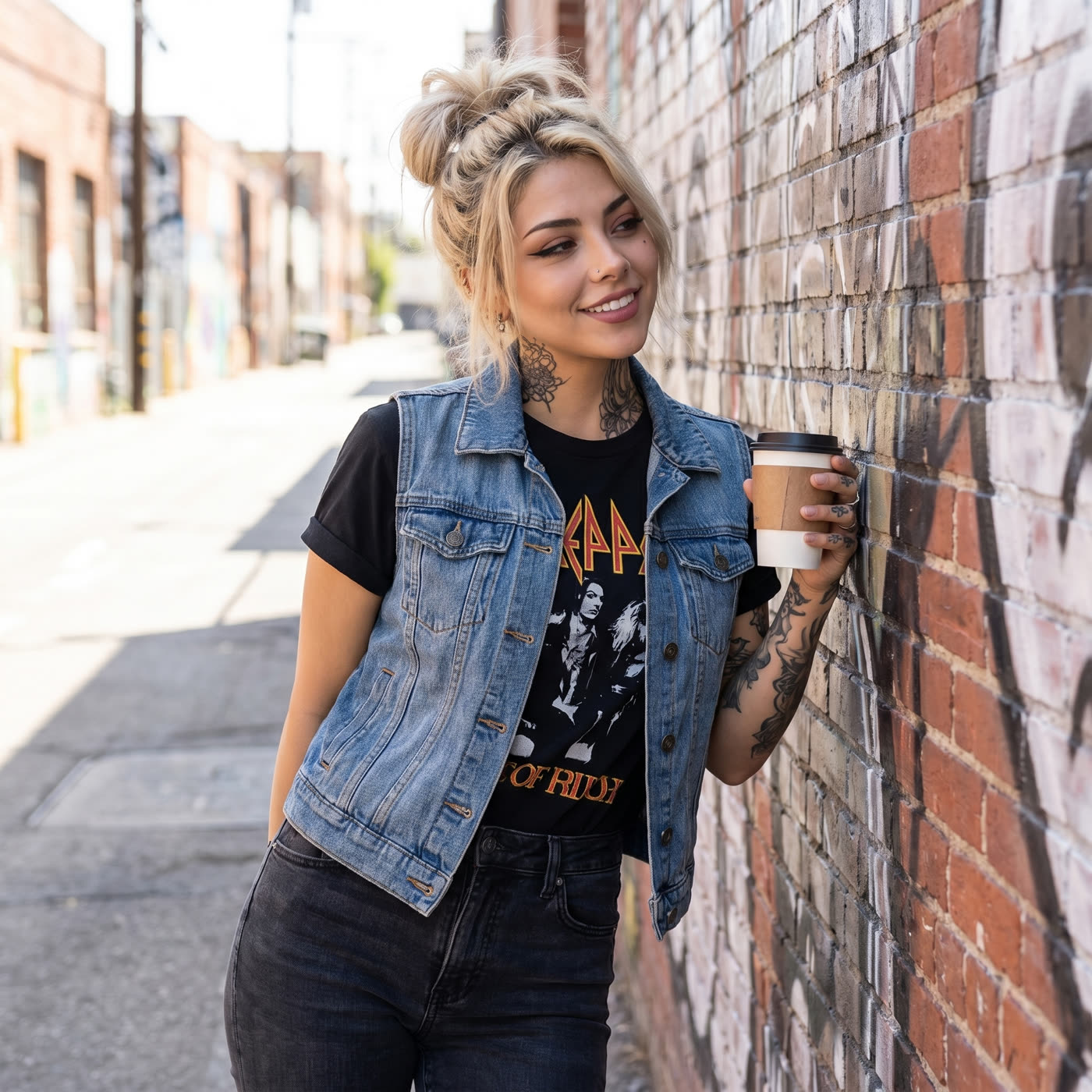
The "blurry background, sharp subject" trend, essentially just portrait mode but with deliberate framing, also worked once I understood what I was doing wrong. First attempts: too close to the background, so the blur wasn't distinct. Final attempts: me about five feet in front of the brick wall, phone several feet in front of me, and the separation was clean. The brick wall on the side of my building photographs like I intended it to be there. I did not intend it. It just exists. I've been living here for three years and the wall has been in the background of things without me noticing it was good. Noticing is something.
The grain-film edit trend, where you add a light film grain and slightly desaturate, worked for the shots where I wanted a specific mood and the phone camera's native image was too sharp and too bright. The album has an analog quality, I tracked most of HEATHEN HYMNS on gear that isn't state-of-the-art on purpose, and photos that look a little worn fit that aesthetic. I used it selectively. It looks wrong on certain shots and right on others. The learning was figuring out which.
the ones that did not go well
The mirror selfie trend with multiple reflections. Theoretically: you find a setup with two mirrors, angle them so you can get yourself and your reflection and the reflection of the reflection, creating this layered visual effect. What I have in my apartment: the bathroom mirror and a handheld mirror that is approximately the size of a paperback book. I spent thirty minutes trying to make this work. The results looked like I was attempting to document a crime. I'm sure with two large mirrors and some spatial reasoning this would be fine. I had neither of those things.
The "golden hour through a window" silhouette trend. In theory: backlit by golden evening light, you become a beautiful silhouette against a warm wash of color. My apartment faces north. I get lovely light for most of the day and approximately eleven minutes of anything that could be called golden hour, and those eleven minutes happen when I'm usually in the middle of something else. I tried it twice. Both times the light had shifted by the time I got set up. Both photos look like someone standing in front of a beige wall. location-dependent, not a personal failure.
The close-crop face shot, just eyes and nose, extreme tight crop, supposed to be striking and editorial, did not work for me and I think I know why. The editorial close-crop works best when there's strong architectural bone structure creating the image. What I have is: tattoos, freckles, and a nose that is entirely my own and that I love but that does not do editorial editorial. The result looked like my face was failing a driving test. No notes for the trend itself; this one was a skill-and-face-architecture situation.
the one that surprised me
There's a trend I'd describe as "motion blur on purpose," walking toward the camera, or turning, while someone films, to create intentional blur at the edges while the face stays sharper. It looks like movement, like someone who has places to be. I tried this expecting it to look ridiculous and it looked actually good? Like something a photographer might choose to do on purpose instead of something that happened when the subject moved too fast.
What it taught me: stillness is a choice, not a default. Most photos I've taken for the rollout have been still-Vixen, composed-Vixen, posed-Vixen. The motion blur shot is a different kind of picture entirely. it says something about being in motion, in process, not arrived yet. Which is also where I actually am, the album is out but the story isn't done, the rollout is still happening, I'm still becoming whatever this period is making me. The photo that shows movement might be the honest photo.
That one is currently my favorite from the whole experiment. I used it. It's out in the world. Came from a midnight trend-testing session and a happy accident that turned into something I meant.
what TikTok photo trends are actually teaching you
The trends are not teaching you their specific tricks. They're teaching you the underlying principles those tricks are built on. When you try the window light and it works, you're learning about light direction and diffusion. When you try the blurry background and figure out the spatial relationship you need, you're learning about depth of field. When you fail the close crop, you're learning about what your specific face is and isn't doing in a frame.
I don't have a formal visual arts education. I'm a musician who takes her own content photos because I cannot always afford the alternative. The trend tutorials are a weirdly effective way to learn composition principles in a practical, applied, immediately feedback-generating way. You don't read about light quality, you stand in your kitchen and face the window and take eleven photos and eight of them work and you understand something about light quality in your body now.
I'm going to keep trying them. I'll spare you the mirror situation. But the rest of it, useful, accessible, occasionally humbling in exactly the ways that useful learning usually is.
The larger thing all of this points at: most skills that seem inaccessible are actually just principles in disguise, and the principles are learnable if you're willing to fail in public a few times first. I have no formal photography training. I've never taken a class. What I've accumulated is observational knowledge from years of being in front of cameras for promotional purposes, watching photographers make decisions about angle and light, noticing what makes a good shot feel different from a mediocre one, slowly building an intuition for what my own face does in different conditions. The trend tutorials accelerated that. They gave me permission to try things that I would have considered "above my skill level" if I'd thought of them as Photography with a capital P. Instead they're just: face a window. Give the background distance. Let the motion be motion. Those aren't intimidating. Those are instructions.
The rollout has needed more visual content than I had built-in answers for. I've been making it up as I go, some weeks I have something intentional, some weeks I'm pointing a phone at a brick wall and hoping the composition does something. The photo trend experiments gave me a toolkit I didn't have before and they didn't cost anything except evenings that might otherwise have been going slightly more stir-crazy. I'll take that trade. The motion blur shot is currently on my bio page. The mirror disaster is in the void, as it should be. Progress is non-linear and you should photograph it anyway.
If you've tried any of these trends with actual good results, send them to me @vixenraefr. I'm building a mental library of what works and I need the data. Also I might be slightly competitive about this now. The motion blur shot has set a personal bar.