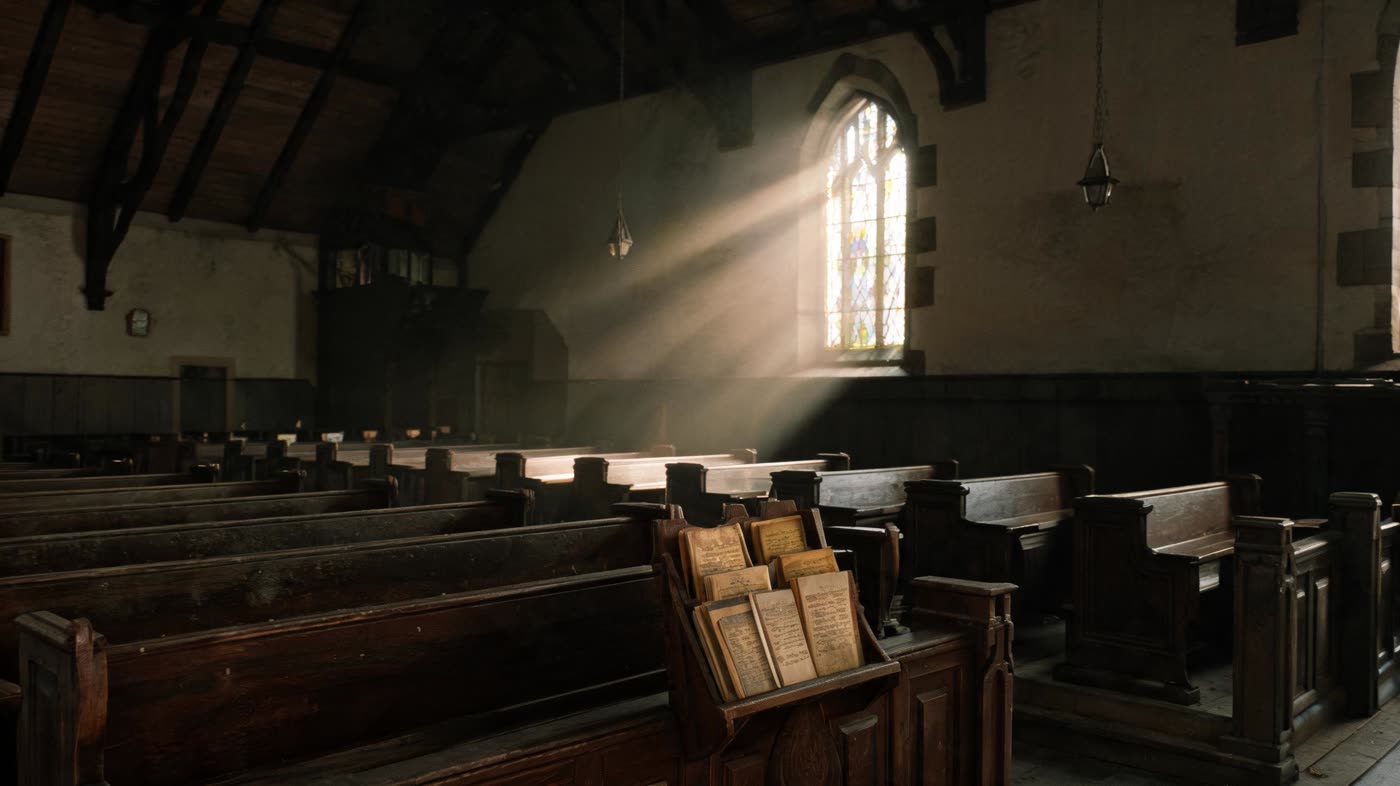
I've been in a particular mood the last few weeks. The kind where nostalgia creeps up on you in the middle of doing something else. I'm elbow-deep in tracking guitar at midnight, or I'm drinking my cold coffee at the window, and something arrives that isn't sadness exactly but rhymes with it. A kind of ache for something specific. Not for the faith, I've made my peace with the faith and that ache has a different color. This ache is for the church itself. The building. The people. The very particular texture of that life that I left and can't go back to.
I'm writing about it today because I think the honest version of my story requires both sides. I've written about the theology I couldn't hold anymore, the passages that didn't reconcile, the harm that was done under the banner of protection. All of that is true and I stand by every word of it. But the honest version also includes this: there was real good in that place and I miss it and that grief doesn't contradict my conclusions. It coexists with them. This post is about the coexistence.
the potlucks
I am going to start with food because food is where I always start when I'm talking about something I love and miss, and if that seems like a deflection it isn't. The potlucks were, and I mean this, some of the best eating of my life. Every Sunday, or at least several Sundays a month, the fellowship hall would fill up with home cooking from the women of the congregation. My aunt Deb's deviled eggs, which I have never successfully replicated despite having the recipe. Someone else's green bean casserole. The macaroni and cheese that belonged to a woman named Louise who has since died and taken the recipe with her, and I am still not fully over this.
There was a generosity of spirit in those potlucks that I haven't found replicated anywhere else. It wasn't just that the food was good, though it was. It was that the food was an act. An expression of something. You made the thing and you brought it and you watched people eat it and you felt the specific warmth of having fed someone. The potluck table was a weekly act of collective care and it was genuine. Nobody was performing it for an audience. They were just feeding each other.
I miss that. I miss the kind of community where showing up with a dish is understood as love. Where the medium is the message and the message is: I made something and I want you to have it. The city has food communities, farmers markets, dinner clubs, neighbors who bring things occasionally, but it's not the same architecture. The church potluck had a frequency and a reliability and a communal expectation that made it structural. You could COUNT on it. That kind of dependable care is genuinely rare.
harmony: the actual sound of it
The music. God, and I use the word culturally, the music in those small Southern churches. Not the contemporary worship stuff, though we had that too. I mean the hymns. The way a congregation of people, some of them with no formal training, would find four-part harmony on something like "How Great Thou Art" and the room would fill with it. Bass voices underneath, the tenors carrying the melody, the altos and sopranos layering above. Not perfectly, not in tune every moment, but with a conviction and a warmth that produced something genuinely beautiful.
I was in the choir from the time I was old enough to stand next to the adults and hold a hymnal. I learned harmony by osmosis, by standing next to my grandmother, who sang alto, and following her pitch until my ear found its own place in the chord. That is how I understand music at a cellular level: as voices in relationship, finding their place in a shared structure. Sunday, my beat-up acoustic, is named for the day those chords filled my world for the first time. The name is not an accident.
I don't have that sound in my life now and I miss it more than I expected to. The record I'm making is, in part, trying to do something with that absence, to build harmonies that have the warmth of what I grew up hearing without the ideological freight of where I heard it. Whether that works, whether it's possible to separate the sound from the system that produced it, is something I'm still figuring out in the sessions. Some days I think yes. Some days the chord I'm chasing feels like it belongs to something I've walked away from and I can't quite borrow it cleanly. That's honest.
the casseroles when someone was sick
This one is specific and I think it's actually the heart of what I'm trying to say. When someone in the congregation was sick, really sick, not a cold but a surgery, a diagnosis, a loss, the church mobilized in a way I've never seen replicated outside of that structure. Within forty-eight hours of bad news there would be a rotation. People signing up for what day they'd bring food. The person or family in crisis would not cook for weeks. They didn't have to think about it. It just arrived, carried by someone who knocked on the door, handed over the dish, said something warm, and left without requiring anything in return.
That is a SYSTEM. A functioning, reliable, human system for care. It didn't require a government program or a nonprofit or an app. It required a community that felt genuine obligation to each other and had the structure to act on it. The church provided that structure.
I have lost people since leaving the church and I have experienced the secular version of that care, friends who showed up, people who checked in, and it was real and I'm grateful for it. But it's dispersed. It relies on the initiative of individuals in my own network who are also living their own complicated lives. The church version was institutional. It was expected. It had a coordinator and a sign-up sheet. That infrastructure, whatever I think about the theology behind it, was genuinely functional and I miss what it could do.
the price of admission
Here's where I have to be honest about the other side, because I can't sit here and write a nostalgia piece without naming what the community asked for in exchange for the potlucks and the harmony and the casseroles.
The price of admission was conformity. Not the benign kind, not "we all eat casserole instead of sushi, ha ha," but the kind with real teeth. The community cared for you if you were the right kind of you. It fed you if you fit the right categories. The belonging was conditional in ways that weren't always stated but were absolutely enforced. I watched people who didn't fit, kids who were different, adults whose marriages broke, teenagers who asked the wrong questions, get the care slowly withdrawn as they departed from the expected shape.
I watched this from the inside, as someone who fit for a long time and then stopped fitting. And the warmth of the potluck is real and also the conditional nature of the warmth is real. Both things are true. The care was genuine and the care was also a form of control. Those aren't mutually exclusive, which is the part that's hardest to explain to people who haven't been inside it.
The church taught me what community could be, in the sense of function and warmth and reliability. It also taught me, by eventually withdrawing from me, what community conditioned on your identity costs. Both lessons are mine. I carry them at the same time.
the ache, and what I do with it
There's a line I've been trying to write for the record for months now. It's about this specifically, not about the theology, not about the harm, but about the specific texture of loss when the thing you're losing was genuinely good. The feeling of grieving something you also had to leave. That particular register of sad.
I keep getting close to it and it keeps sliding away. Which might mean I'm not far enough from it yet. Or it might mean that the experience is genuinely double-natured, simultaneously true in both directions, and a single song line can't hold both at once. Maybe that's why I'm writing this instead. Maybe this is where the contradictions have room to breathe.
I don't want my story to be the story of someone who left and then flattened everything they left into a caricature. The truth is more complicated. The truth is that I was genuinely loved there in the ways that community was capable of loving, and I experienced something real, and it also asked a price I couldn't keep paying. Holding both of those truths at the same time is its own kind of ongoing work.
I think about my grandmother's church, and her deviled eggs, and the harmony on a Sunday morning, and the sign-up sheet for casseroles, and I feel the ache. I don't need it to resolve. I just needed to put it down somewhere. This is where I put it.
If you've been there, if you left something that was both genuinely good and genuinely untenable, I see you. The grief is real even when the leaving was right. You don't have to choose. You can miss it and know why you're gone, at the same time, forever. That's allowed. That's human. That's the whole complicated thing.